From Seed to Grove: Our 50th Anniversary Gala
Images and memories from our school’s 50th anniversary gala.
Since its founding in 1972, Marin Waldorf School has grown from acorn to oak grove. Today, we are a school community anchored by 50 years of history, with roots reaching out to the thousands of students, teachers, parents, and neighbors who have been part of our community over the generations. And that is something worth celebrating!
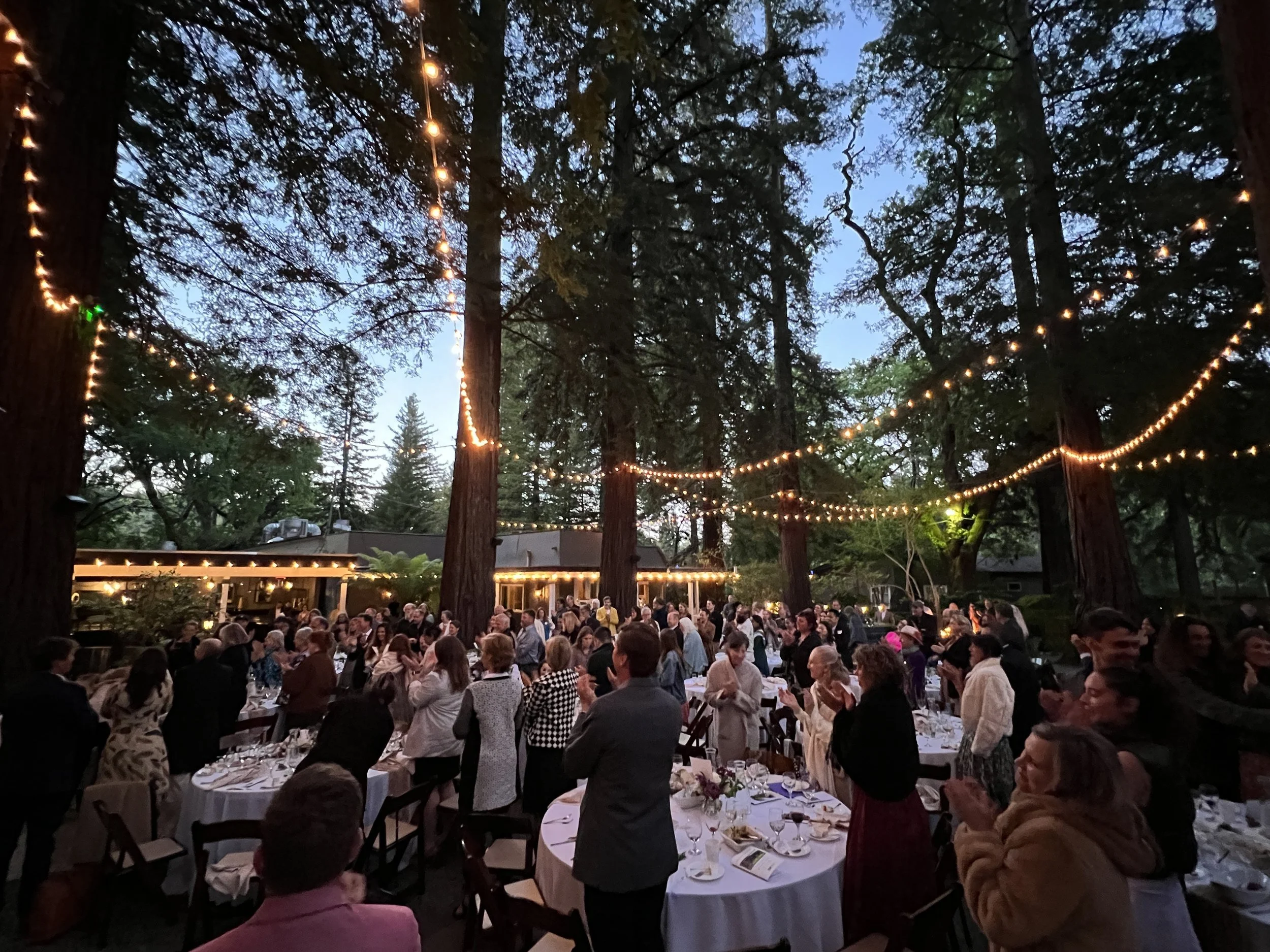
On Sunday, May 14, we had an opportunity to acknowledge, thank, and celebrate the many families, teachers, neighbors, alumni, and friends who have made Marin Waldorf School the extraordinary place it is today. At 50th anniversary gala, From Seed to Grove, close to 200 current and former faculty, staff, families, and students came out to share memories over bubbly, hear beautiful speeches from former faculty Karen Rivers and Kristine Deason, and gather for dinner under a canopy of redwoods. A highlight was the performance by cellist Michael Fecskes, who discovered his passion for strings while in 4th grade at Marin Waldorf School; Michael played two pieces he composed specially for the event.
Below enjoy some of the photos from the event! So many smiles! If you have photos or memories to share, please reach out to Julie at juliemeade @marinwaldorf.org.
Special honoree of the evening, Manette Teitelbaum, is pictured below with Class of 2012 alumni Bella, Will, Fielding, Lily, and Jack at our school's 50th Anniversary Gala. Manette has touched the lives of thousands of students during her 40-year career at Marin Waldorf School, where she has served as a class teacher, handwork teacher, member of the Board of Trustees, chair of the College of Teachers, and more. Among Manette's many valuable contributions to our school was her involvement in the creation of our student library. As the primary library administrator, Manette helped to build and shape this beautiful and edifying space. Manette received special honors and a all-house standing ovation at our 50th Anniversary Gala, where we officially announced the dedication of our library to her legacy, as The Manette Teitelbaum Library.
A Rite of Passage at Headwaters Outdoor School
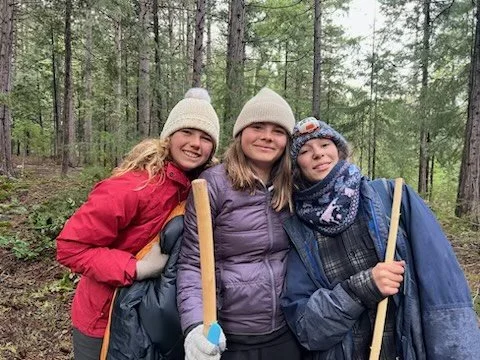
This year, our 6th and 7th graders took multiday trips to Shasta with Headwaters Outdoor School. For 7th grade, a challenging rite of passage was a part of the experience, in which each student spent a whole night alone in the wilderness. Read more about their experience, as described by their teacher Ms. Percey.
In Waldorf education, building a relationship with nature is central to a child’s development. Time outdoors teaches children about the Earth’s natural rhythms and cycles, allows them to experience natural phenomena before studying them in a classroom, and fortifies the child’s relationship with and respect for the natural world.
At Marin Waldorf School students in every grade, starting in preschool, spend a large part of their day outside, rain or shine. Kindergartners take weekly hikes in the hills near campus and learn that, as the saying goes, “there is no such things as bad weather, only bad clothes.” Throughout the grades, the relationship with nature that was built in early childhood continues through gardening, environmental education, hikes, and outdoor education trips. For many of our students, a snowy ascent up Mt. Shasta or jumping into nearby Miller Creek during an environmental education class may be among their best memories at school.
This year, our 6th and 7th graders took multiday trips to Shasta with Headwaters Outdoor School. For 7th grade, a challenging rite of passage was a part of the experience, in which each student spent a whole night alone in the wilderness. It was a demanding, inspiring, profound, life-shaping experience for our students. Below, please read teacher Rising Percey's letter to parents following the trip.
100% Success!!
All students completed their Rite of Passage on Wednesday night. I am beyond proud of every one of these students. It was impossible not to shed tears as they returned to camp in the morning.
Each day they learned the skills they needed to connect with and feel at home with nature. They learned to build a shelter, and even adorn it with an altar. They learned to reflect on their life: who they wish to be, and what values matter to them. They created a Code of Honor that they took with them for their “sit”: a 17 hour challenge, alone in the woods, no food, no talking with anyone; just a time to reflect and be with nature.
They’ll tell you more details themselves. But please ask them to share their Code of Honor with you. Also, ask your child to share with you what they shared in the closing circle: their favorite part, the most challenging part, and what they will take with them from this experience.
Tim, our incredible teacher and owner of Headwaters Outdoor school feels it is important that each family take some time to celebrate this Rite of Passage with their child. He also suggests giving a gift to them that represents their arrival into early adulthood. They will now be able to function at a higher level in the home, in the classroom and in the world. They are inspired to take this new step and many reflected in our closing circle the new things they would like to do at home and in nature. They have been coached by Tim to be of service in the home, help when help is needed, spend more time with nature, be a caretaker of the earth, and so much more. Be prepared to see new aspects of your son/daughter showing up in the days to come. This deserves honoring in some way from you.
I heard countless times from the staff here how fantastic this group is. They said their structures were the most creative they’d seen; they noticed this group’s extreme enthusiasm as well as how respectful they are. Tim said to me he could tell all of the amazing work we were doing with them at school preparing them for this moment. You have been a big part of that preparation too and should be equally proud as I am.
—Rising Percey, 7th Grade Teacher
"Ferocious torrents of rain": Using adjectives to describe the storms
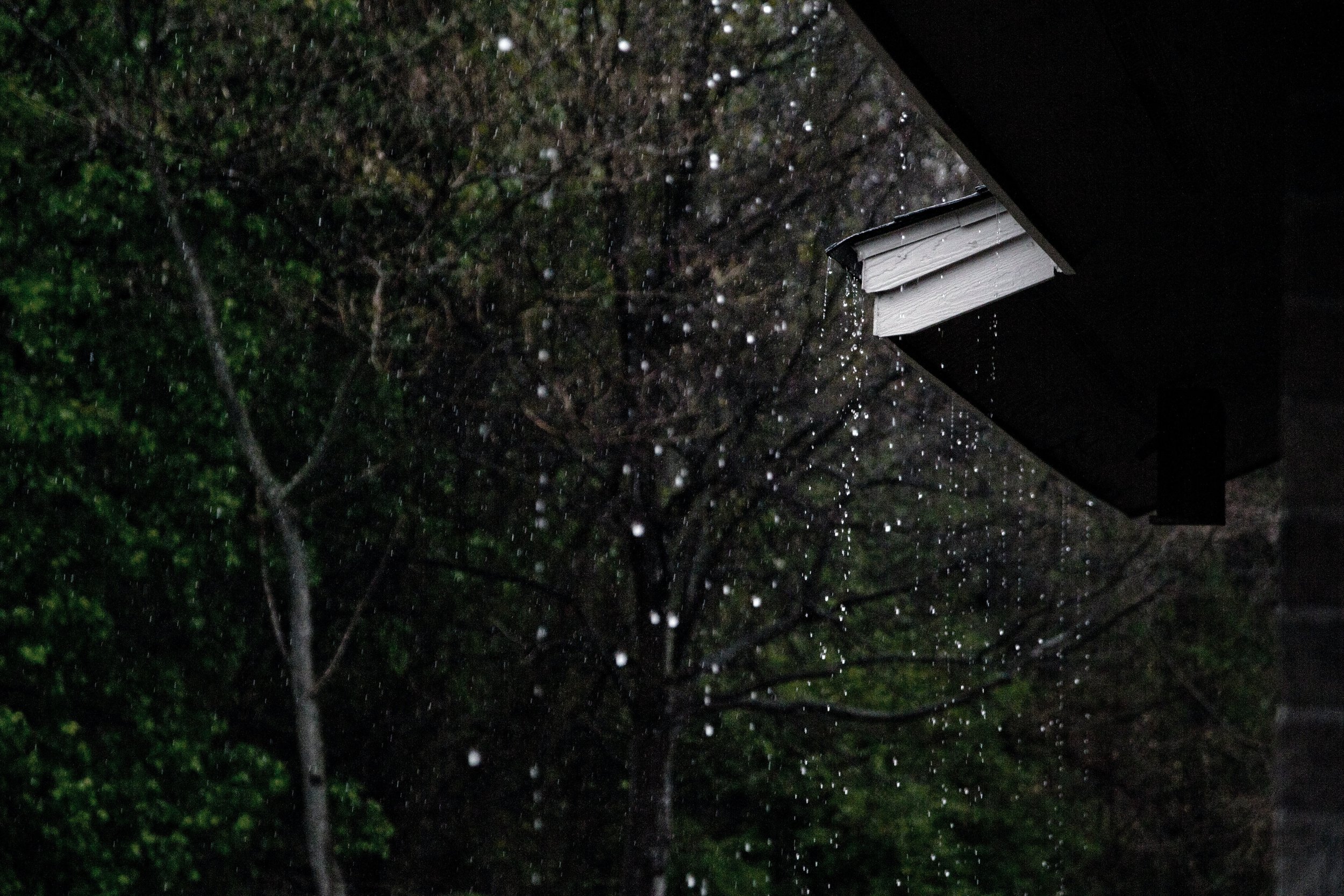
"I watched the ferocious torrents of rain shower onto the road as strong winds blew the remaining leaves off the long rows of skeletal trees on either side of the road. The thick grey clouds rolled with thunder as the sun tried feebly to peek through the sky," writes 5th grader Maya in an assignment to describe the recent rainstorms using descriptive adjectives. Read more of their work.
"I watched the ferocious torrents of rain shower onto the road as strong winds blew the remaining leaves off the long rows of skeletal trees on either side of the road. The thick grey clouds rolled with thunder as the sun tried feebly to peek through the sky," writes 5th grader Maya about the January rainstorms that rolled across Northern California.
“The gigantic clouds approached ominously from the north, a mass of dangerous, wet, powerful weather. Huge trees cracked and skirted across flooded driveways as the wind blew ferociously over the hills, now a bright green,” writes Ava, another 5th grader.
“Standing outside my house with my clear umbrella in my cold wet hands, suddenly gusts of powerful strong wind hits me and nearly knocks me off my feet. I hurriedly go inside my house and sit by the warm fire observing the ferocious storm from a cozy couch, in a warm sweater and thick socks,” remembers Zenen.
From falling trees to lashing winds, the storms provided sensory inspiration for the 5th grade students in their study of adjectives and descriptive language. Seeing an opportunity, 5th grade teacher Ms. Pironti asked her students to practice using adjectives in short essays about the storms. Click on the images to read a couple of samples of their wonderful descriptive essays, written in their own hand. Bravo, 5th graders.
Welcoming the Year of the Rabbit
Led by our Mandarin teacher Sally Li, the assembly was a showcase for our Mandarin program and a colorful celebration of traditional Chinese culture
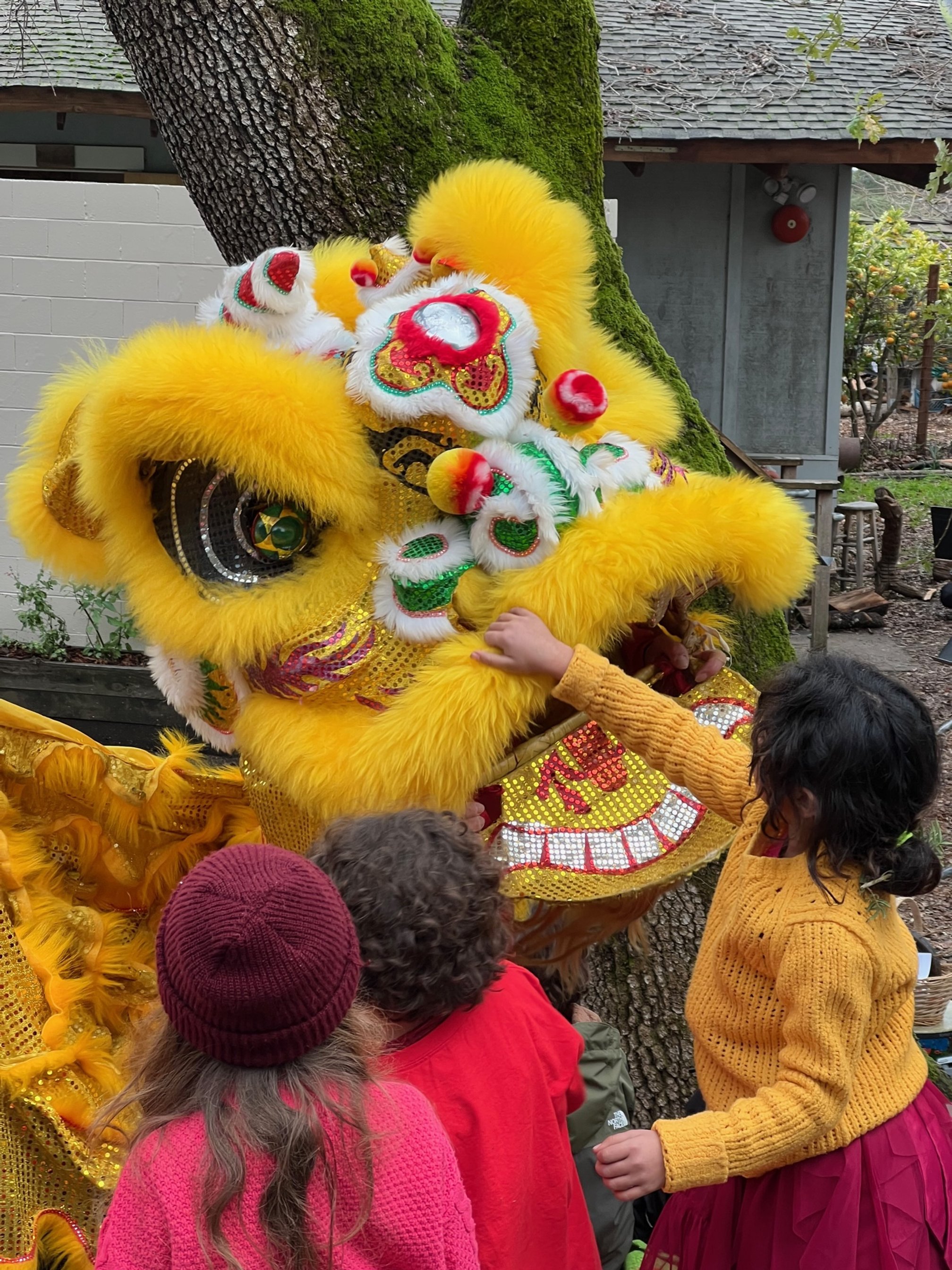
On Friday, the rain stopped for just a few hours, clearing the skies for our annual Lunar New Year celebration in the amphitheater. Led by Mandarin teacher Sally Li, grades 1-8 performed traditional Chinese songs, dances, and music. Highlights included a wonderful traditional bamboo dance performed by 4th grade and a song about homesickness performed by 6th and 7th, accompanied by Ms. Mallard and student Julian on guitars. The the 7th-8th orchestra also joined with a lovely rendition of Jasmine Flower, a traditional Chinese folk song.
In addition to student performances, we were also treated to a demonstration of the martial art White Crane Silat, performed by several local masters and two MWS second graders. And, like last year, the assembly concluded with a traditional lion dance and fireworks in the amphitheater, always a thrilling experience for our students!
DEIJB in 2023
As our faculty continues the important work of creating an anti-racist and inclusive curriculum, we are exploring deep and rich ways to discuss history, activism, and social justice with children across ages and grade levels.
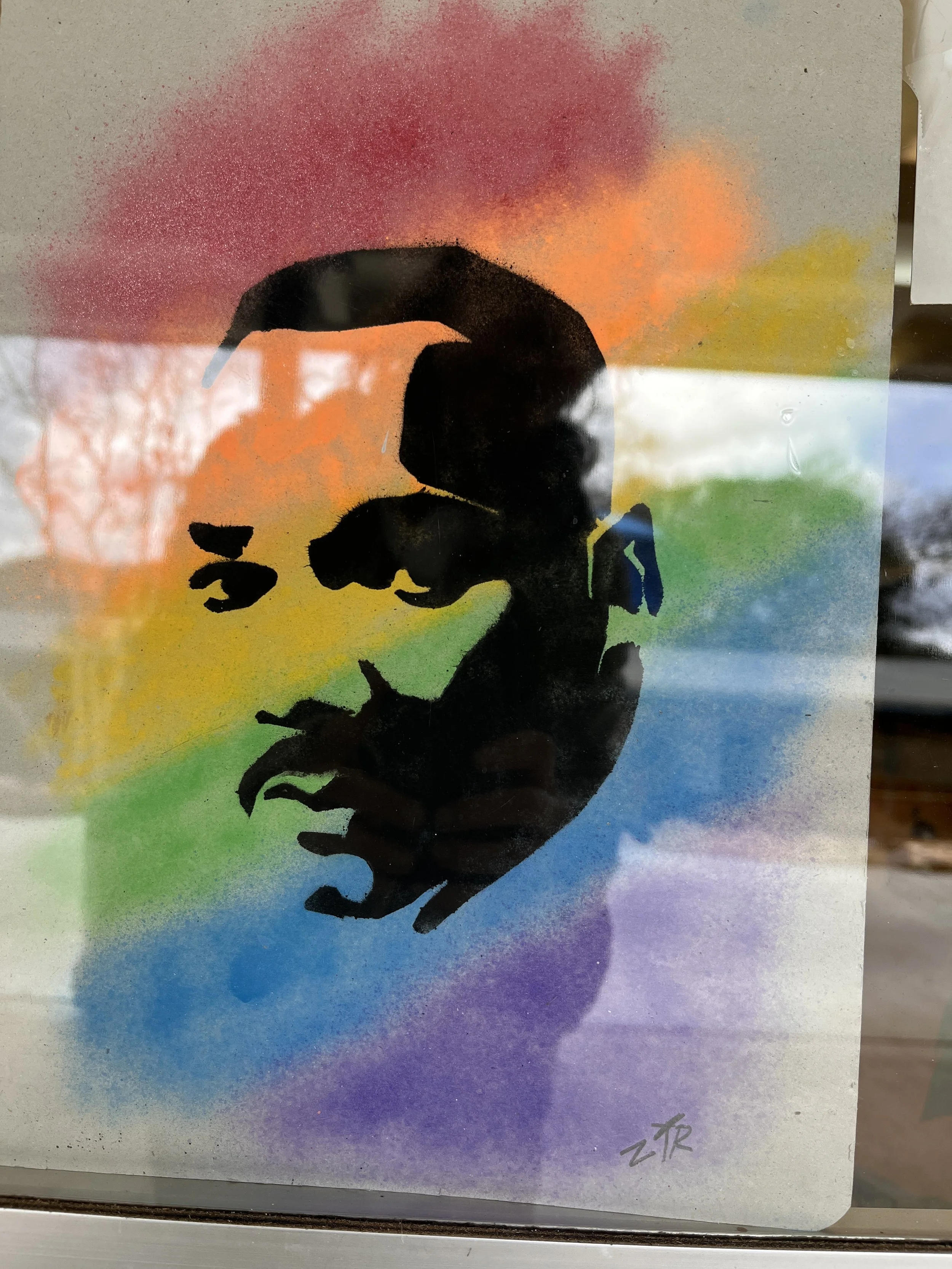
As our faculty continues the important work of creating an anti-racist and inclusive curriculum, we are exploring deep and rich ways to discuss history, activism, and social justice with children across ages and grade levels. The summer of 2020 is several years behind us, but the need for social change remains urgent. In early 2023, we have witnessed a tragic spate of violence and injustice across our country, and right here in the Bay Area.
Before and following the holiday weekend in January, students at MWS learned about, remembered, and discussed the life and work of Martin Luther King in meaningful age-appropriate ways, from preschool to 8th grade. The middle school held the annual Martin Luther King assembly to discuss King's legacy and racial justice today, and faculty listened to and discussed a recording of King's final speech in their weekly meeting. Some of their tributes to MLK are still hanging in the windows of the classrooms, continuing to guide us through Black History Month in February (above).
Some grades classes also received a special visit from Jack, the 87-year-old father of our kindergarten assistant teacher Carolina and a lifelong activist (pictured left). He shared stories of hiding Jesse Jackson in his car while traveling through the south, attending MLK's "I Have a Dream" speech, and his current work in Bolivia.
At the end of last month, we hosted a parent meeting with Karmin Guzder Williams from San Francisco Waldorf School for a parent evening entitled: DEIJB for Waldorf Families. A parent, activist, and teacher, Karmin is compelling and thoughtful speaker, who has twice led DEIJB presentations for the Marin Waldorf School faculty. In this presentation, she focused on work that parents can do at home. That work begins with looking at ourselves and our surroundings.
“To raise an antiracist child, you must first teach them about their own culture and history. Then, you must teach them about other cultures and histories. And finally, you must teach them about the common humanity that connects all of these different cultures,” writes Ibram X. Kendi in How to Raise an Antiracist, a quote that Karmin highlighted as part of her talk.
With this in mind, Karmin discussed the history of Marin County, sharing some of the past policies and current influences that define our area, the most segregated region in the Bay Area. For many, it was a surprise to learn that Marin County was the backdrop for an influential civil rights case, Joseph James vs. Marinship, which was argued in 1944 by Justice Thurgood Marshall in front of the U.S. Supreme Court. What does understanding this history tell us about ourselves and the place we are raising our children?
Karmin also talked about the history of Waldorf education and how Rudolf Steiner’s work reflects many of the same values as the contemporary fight for social justice. In a conversation before the event, she said, “For me, there's a very clear connection between [DEIJB and anthroposophy]. There's a lot of work Steiner has done about the consciousness moving ahead into the ages and the consciousness soul, and what does that really mean? DEI work is, I think, very aligned with that trajectory.”
We hope our parents were able to reflect on and learn from this and the many other topics Karmin touched on in her presentation, and we welcome your partnership in making our school an evermore equitable and inclusive place. You can about some of our school’s past work/statements on DEIJB here and here.
Spotlight on Handwork 2023
Incorporating a wide range of media and ideas, grades handwork teacher Ms. Piderman has led our grades students in creating beautiful pieces that they are proud to share with us and take home to their families. See some of their creations!
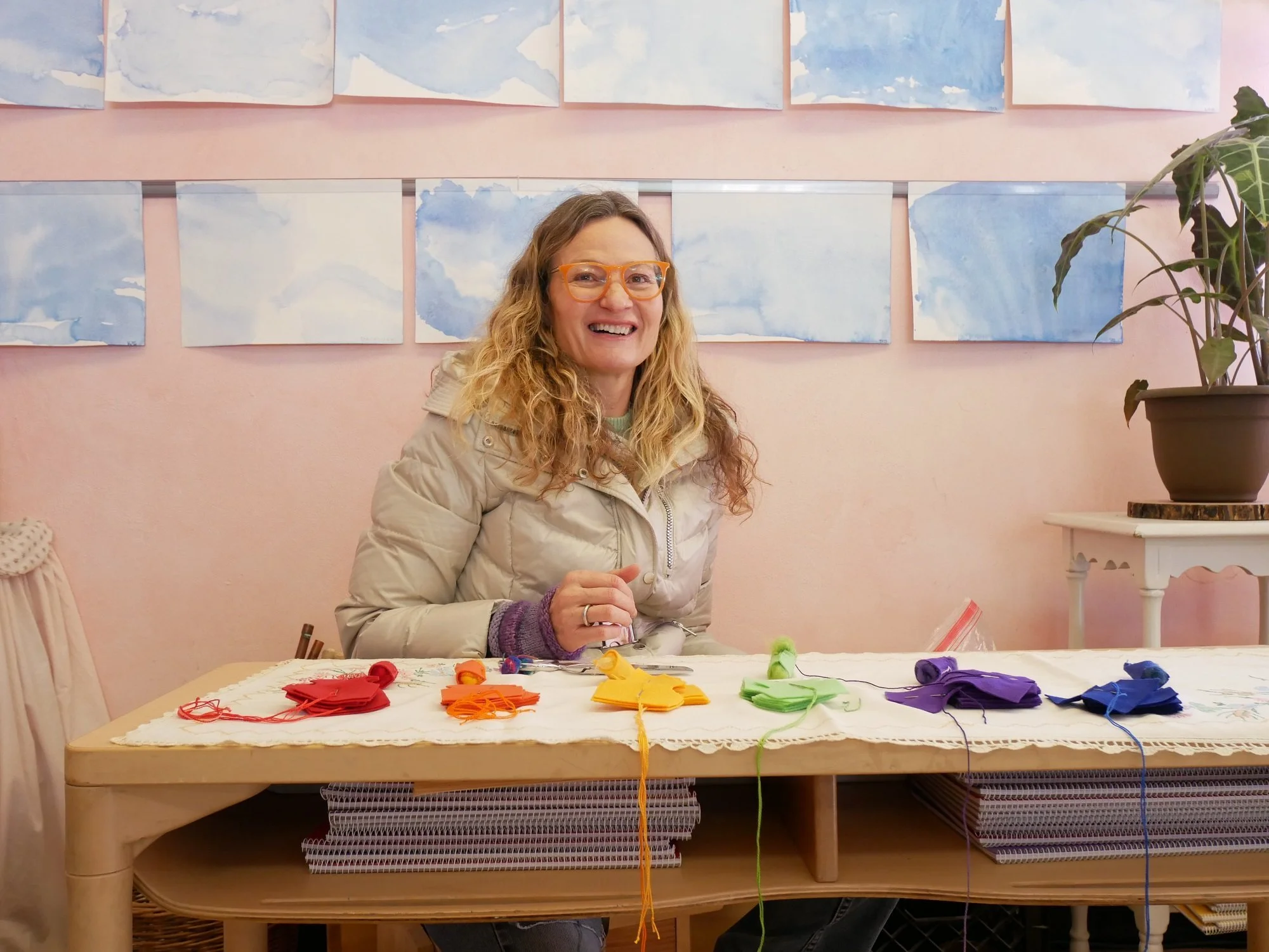
We are fortunate to have artist extraordinaire Meret Piderman leading the handwork program in grades 1-8 for 2022-23. Incorporating a wide range of media, techniques, and imagination, Ms. Piderman has led our grades students in creating beautiful pieces that they are proud to share with us and take home to their families. We want to share some of that work with you.
1st grade sewed sweet gnomes and knitted little friends.
2nd grade also did some quality knitting projects! Some students made dragons—a project well suited to the 2nd graders, who performed as the brave knights who tamed the dragon in our fall Michaelmas pageant.
3rd grade has been busy in handwork class, dyeing silks with a tincture made from avocado pits, learning to crochet, and creating ceramic teacups by hand. The teacup project was conceived when Ms. Piderman received a collection of antique saucers, which she gave to each student to accompany their tiny mug.
In 4th grade, the delicate and detailed work of embroidery was introduced. Each student is embroidering their own linen handwork bags.
5th grade has been working on embroidery as well, creating these imaginative felt pouches.
6th grade has kept busy in handwork. Students designed and sewed original stuffed animals and then they sculpted and glazed ceramic turtles and elephants.
Puppets, the traditional 7th grade handwork project, was given movement and creativity by this year’s class. 8th graders have been sewing upcycled denim handbags.
Mud on our Boots: Dispatch from a Rainy Winter
For young children, there's so much to learn from time spent outdoors. Guided by curiosity and confident that their raingear will keep them warm and dry, preschool and kindergartners learn about the world through observation, experience, and play.
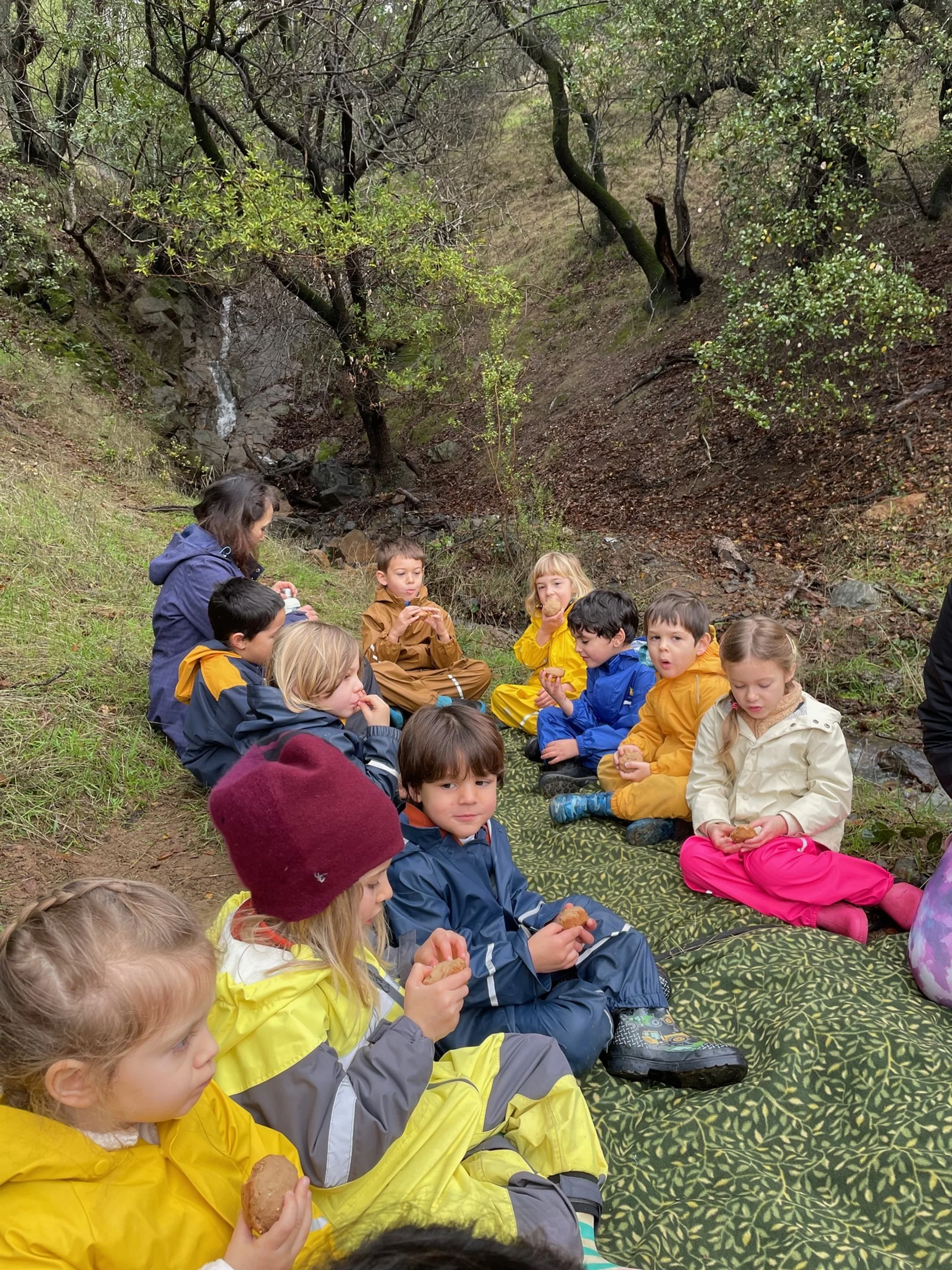
2023 began with an unrelenting succession of storms in Northern California. Here at Marin Waldorf School, we were ready for it! Rushing creeks and wet weather are an invitation to explore for our curious kindergartners, who hike into the open space near school, rain or shine. (More often rain in 2023.) As you can see in the pictures from our hike days below, many of us like a little bit of mud on our boots!
For young children, there's so much to learn from time spent outdoors. Guided by curiosity and confident that their raingear will keep them warm and dry, preschool and kindergartners learn about the world through observation, experience, and play!
And at MWS we know that play, particularly outdoors, is an important entry into the world of math, science, and creativity. Current research supports that. In an interview with Ed Source, Gennie Gorback, president of the California Kindergarten Association, explains, “Children learn high-level, intangible concepts such as the laws of gravity, conservation of liquids/mass, mathematical concepts such as more vs. less, all through hands-on, interactive play.”
On campus, our youngest students spend ample time outdoors. Gardening, which is an integral part of our grades program, begins in kindergarten, where a small garden plot is planted and cared for by the Hollyhock and Morning Glory classrooms.
Want to learn more? We encourage you to read about our multidisciplinary approach to math education in early childhood here.
Craft Project: Simple Window Light-Catchers
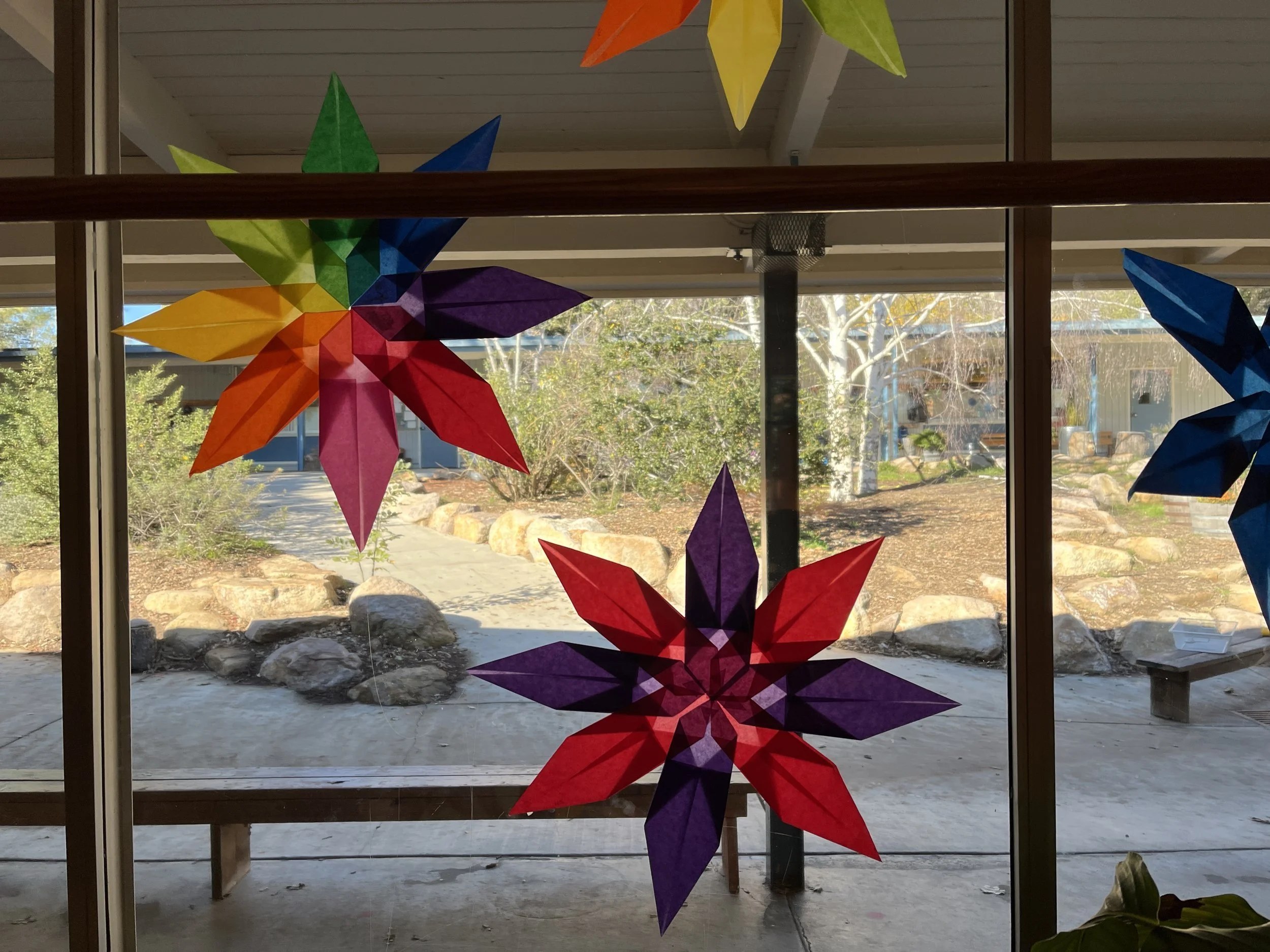
It is a Marin Waldorf School tradition to dress up the school’s many windows with folded paper stars, also called light-catchers, in celebration of the winter and spring seasons. Simple to make and elegant in any window, these seasonal decorations bring a touch of beauty and cheer to every space. All you need is paper and glue. We use semi-transparent kite paper to make ours glow with gentle winter light.
You can make window light-catchers of varying complexity, but we love to make this simple 8-pointed star with children.
Sharing a Meal Creates a Space for Connection and Community | Recipe: Morning Glory Muffins for Sharing
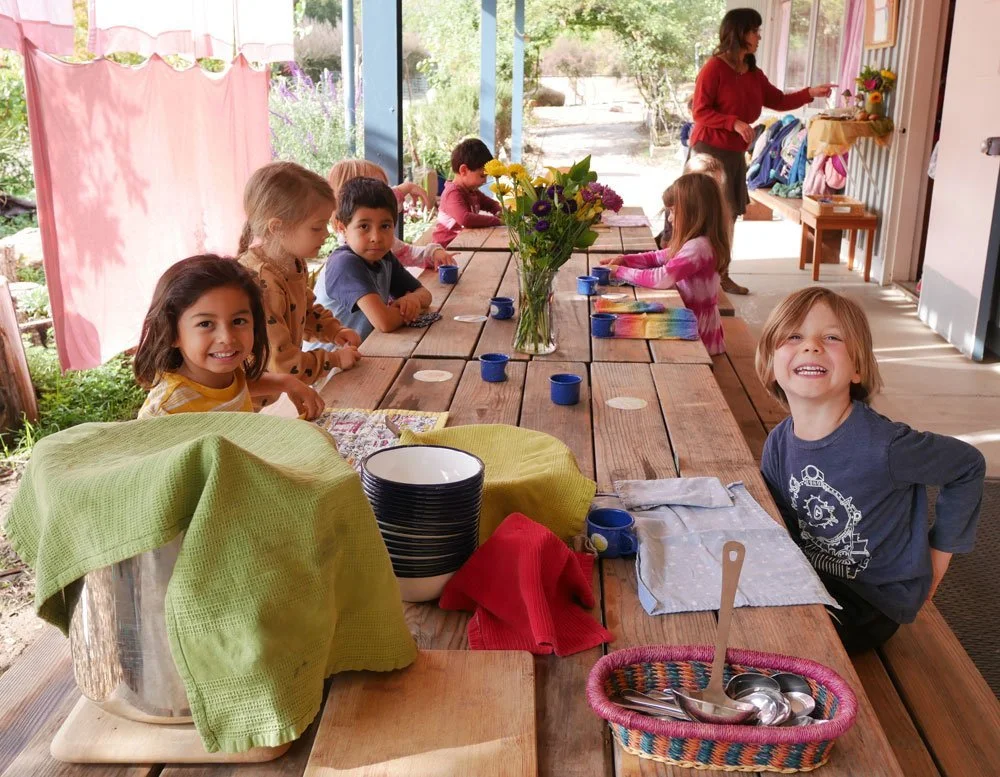
Every morning, students in Marin Waldorf School’s preschool and kindergarten gather around wooden picnic tables to share a warm snack with their classmates. From oatmeal to honey buns, snacks are made from scratch in the classroom and they are always served with just a touch of ceremony: There are fresh flowers on the table, real plates and silverware to eat with, and cloth placemats for each child. The children wash their hands, take their place around the table, and wait to eat until teachers and students are served. Everyone joins hands to sing a song of gratitude—and then it’s time to eat!
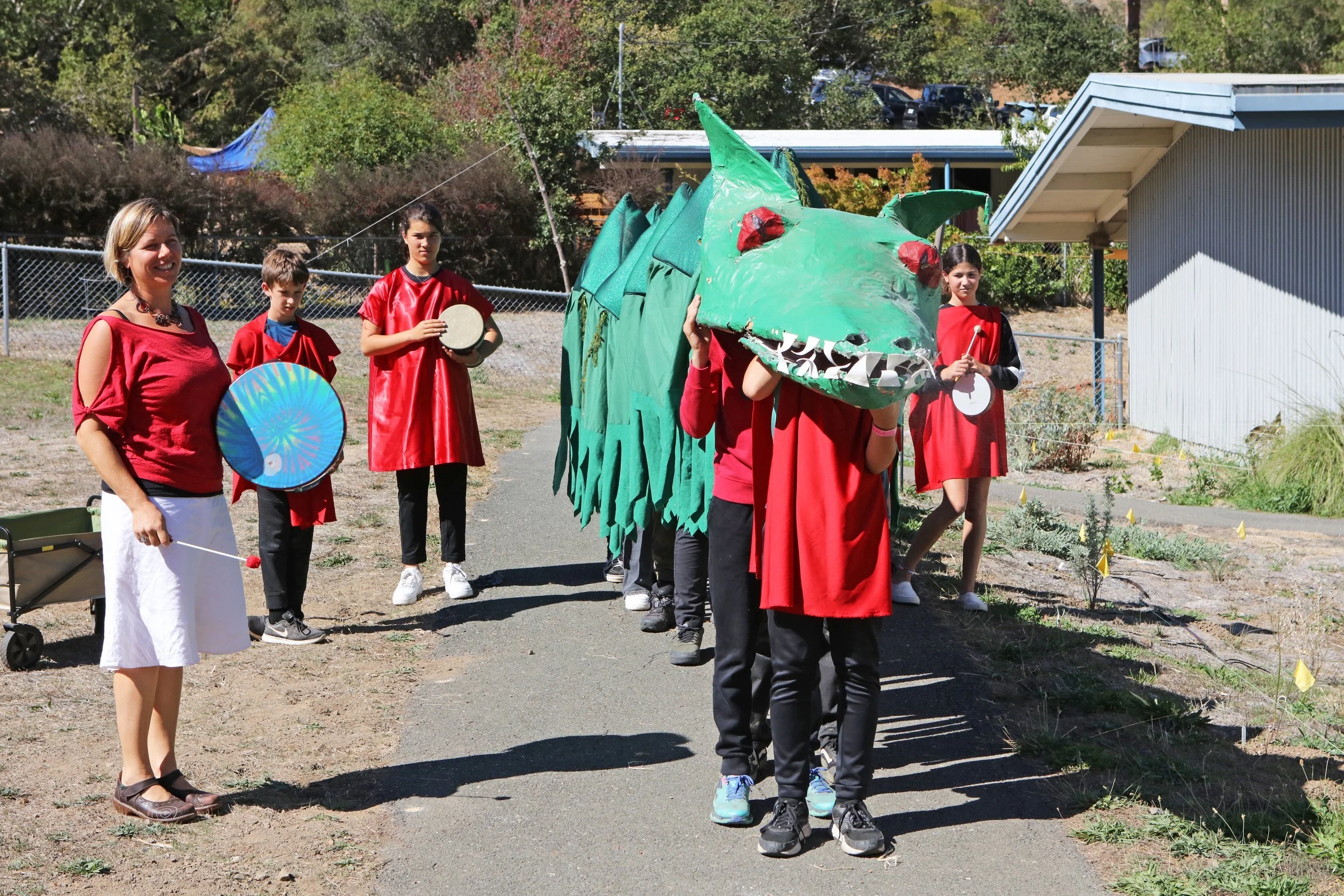
There are many reasons our teachers take care to create this shared moment every day. Sitting around the table together, we learn the importance of courtesy, sharing, and kindness. We learn to slow down and replenish our bodies with healthy foods after a morning of play. Snacks even provide a means of establishing a predictable weekly routine in our preschool and kindergarten, as we learn to recognize the days of the week by the food we share at school: Monday is “rice and beans day,” Tuesday is “oatmeal day,” and so on.
But snacks are more than that. Whether it’s a special occasion or an everyday event, sharing a meal creates a space for connection and community between people. In fact, researchers at the University of Oxford found that “communal eating increases social bonding and feelings of wellbeing, and enhances one’s sense of contentedness and embedding within the community.” Other research has shown that people who eat together eat more nutritious food!
It’s easy to see all the comfort and bonding of a shared meal in our early childhood classrooms. You can see the joy in their faces as children prepare the table. You can sense the comfort they feel when eating something nourishing. Even picky eaters come back for seconds (and thirds) of a favorite morning snack! And, on chilly autumn mornings, the smell of warm soup or baking whole-grain muffins makes our classrooms feel like home.
Can you picture your child in this warm environment? If so, we invite you to come visit Marin Waldorf School & experience preschool and kindergarten snack time in person at one of our upcoming small group tour dates: Oct. 27, 28 & Nov. 2, 3, 10, 11.
To share a little slice of our morning snack with you, we asked our teachers to give us a favorite recipe from the classroom. Slightly sweet from the addition of maple syrup and lightly spiced with vanilla and cinnamon, these millet muffins from the Morning Glory Kindergarten use three types of flour, making them toothsome and nutritious. Enjoy!
Morning Glory Millet Muffins
Note: This recipe is made for sharing! Following the measurements given here, you can feed a kindergarten classroom. So bring these muffins to share at a potluck or party, or tuck some away in a freezer bag for later.
Michaelmas: Kindling Light
As the nights lengthen and the weather begins to cool, it is time to shine our inner light, finding the courage and strength to carry us through the darkness of the winter months. At Marin Waldorf School, we celebrate the autumn season and the kindled light of our community at the Michaelmas pageant, held annually in late September.
Fall is a splendid season in Northern California. As we near the autumn equinox, the brilliant sunlight, deep blue skies, and leafy green canopy of trees bring a special beauty to our campus. At the same time, we see the signs of coming winter in the crisp morning air, the falling oak leaves, and, sometimes, an early season rainstorm. As the nights lengthen and the weather begins to cool, it is time to shine our inner light, finding the courage and strength to carry us through the darkness of the winter months.
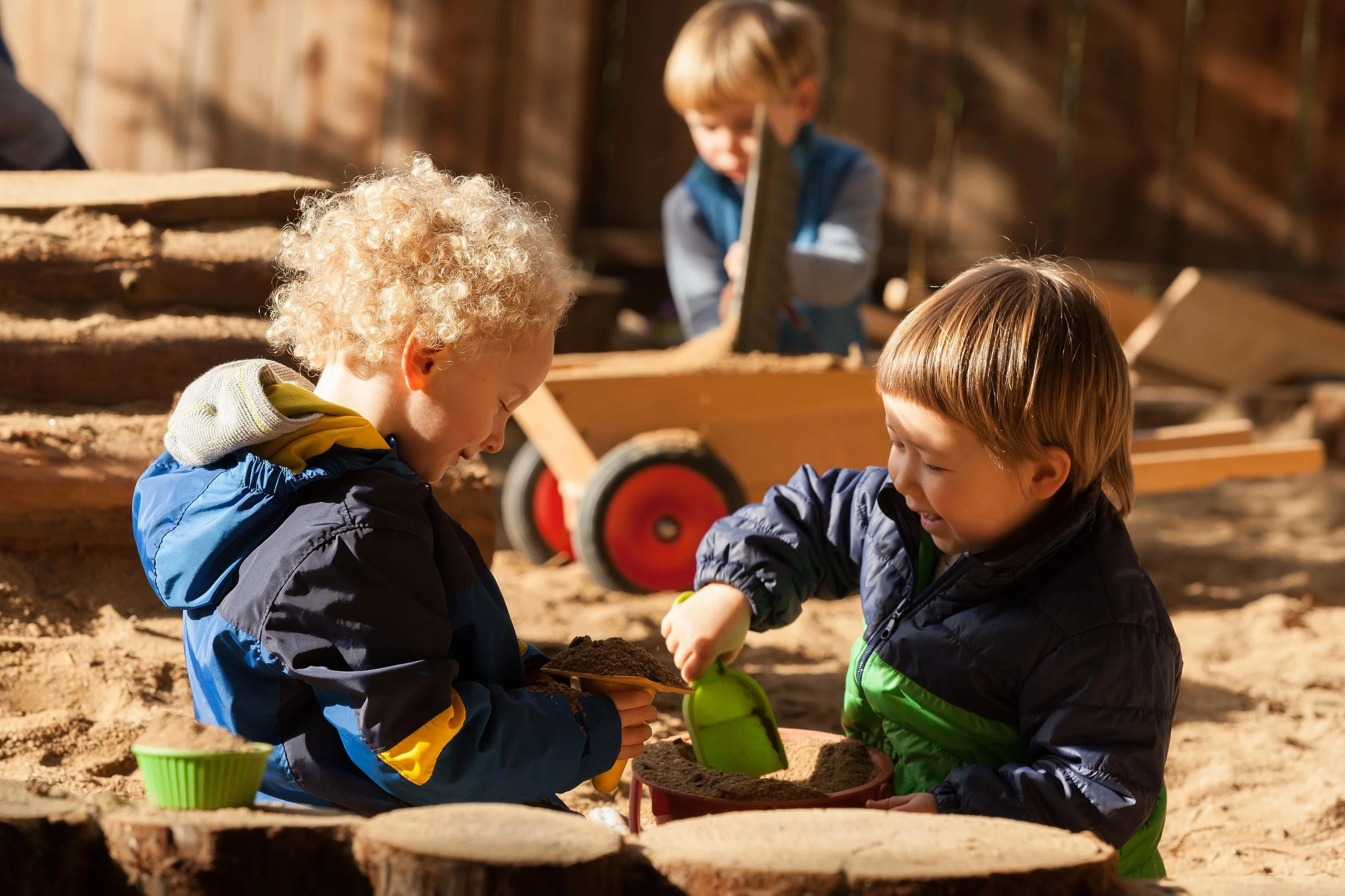
At Marin Waldorf School, we celebrate the autumn season and the kindled light of our community at the Michaelmas pageant, held annually in late September. The first festival of the school year, the pageant recounts the story of Saint George and the battle between the archangel Michael and the dragon. Through songs and verses, the children introduce us to the people of the village who are terrorized by a fearsome dragon, the brave knights who defend the people, and the dragon itself, who appears amid a cloud of smoke and marching to the rhythm of a beating drum.
The pageant is performed by grades 2 to 8, with each class taking a role that is assigned to their grade; in this way, as children grow older, they will play every role in the pageant—making the experience a rite of passage. As with many of our festivals, the lessons of Michaelmas are also intertwined with the curriculum. For example, second graders, who play an important role in the pageant as the knights who tame the dragon, learn about Michael’s qualities of courage, compassion, and steadfastness as part of the larger second grade curriculum, through which they study the lives of inspiring people from around the world. On a deeper level, we can each think of the dragon as those things that prevent our awakening to our own humanity.
“Autumn is a time of transition. With attention, we can become sensitive to the subtle but profound changes in nature and notice what is called for inside ourselves to prepare for the coming darkness that winter brings,” explains MWS director, Megan Neale. “In many Waldorf schools in the northern hemisphere, Michalemas is the festival that celebrates and honors this transition and inner preparation. Many of the native people in California also celebrate this time, honoring the harvesting of the acorn that brings life and sustenance throughout the winter months. For the farmers, it is a time to begin to put the land to rest after an active growing season through the summer. There is preparation required for this transition to take place.”
Parents and our extended school community are encouraged to join us in the audience for the pageant at 2:20pm in the oak grove on Friday, September 30. (Please remember, per our school’s media policy, no cell phones/photos please!)
Early Childhood and Math
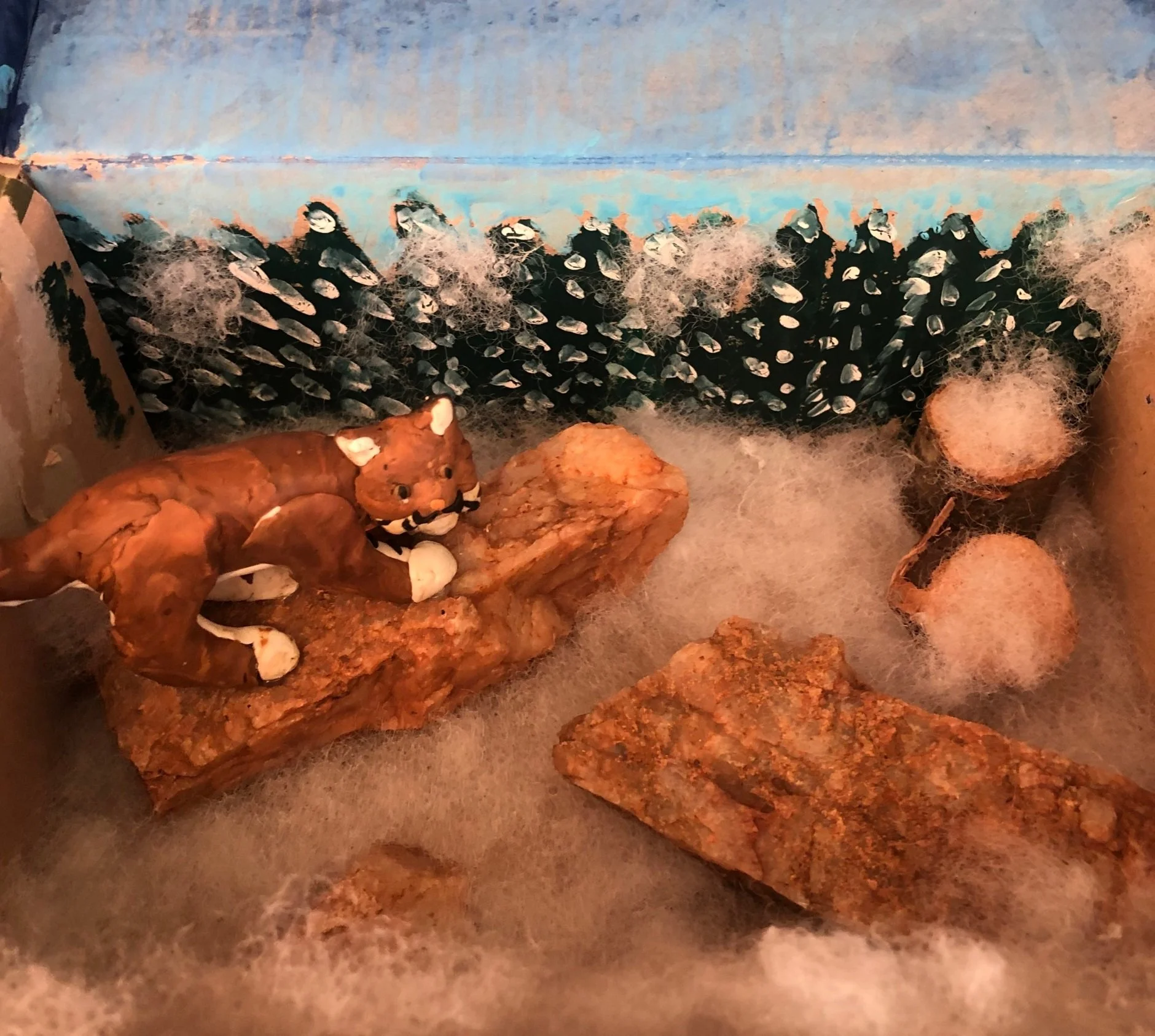
Babies and children love math. Give them some wooden blocks and they will happily spend long periods of time building and arranging them—and knocking them down. Children will look up at the sky and be delighted by the V formation of birds flying overhead. They are fascinated by a daisy and happily pull off each petal in turn. Split a treat to share and you can be sure a child will ensure it is exactly in half.
by Julia McIlroy, middle school math teacher and MWS math program director
Babies and children love math. Give them some wooden blocks and they will happily spend long periods of time building and arranging them—and knocking them down. Children will look up at the sky and be delighted by the V formation of birds flying overhead. They are fascinated by a daisy and happily pull off each petal in turn. Split a treat to share and you can be sure a child will ensure it is exactly in half.
In fact, science has proven that we are adept mathematical thinkers from an early age. Even babies notice when there’s an unexpected number of objects. However, as soon as children enter school, their confidence in their mathematical abilities declines with every passing year. So what are we, as a society, doing wrong? Or perhaps, the better question is how is Waldorf getting it right?
During my first child development class in college, I was stunned to recognize how developmentally attuned Waldorf education is. Every developmental milestone is met with an appropriate curriculum that supports and nurtures it, in ways science and educators are just now figuring out how to study and quantify.
For example, in a recent journal article, Stanford education researchers noted the importance of fingers to mathematical understanding. Finger perception in first grade is a better predictor of math achievement in second grade than tests. Even college students’ finger perception predicts their scores on calculation tests. In fact, musicians’ achievement in higher mathematics, a relationship that has been noted for many years, is now thought to be due to their opportunities to develop good finger perception.
At the end of the article, the Stanford researchers say that unfortunately, there are no known educational systems that include finger play in their curriculum. But there is one. Waldorf teachers have been integrating finger play from preschool into the grades for the last century.
Watching the ease and joy of a preschool or kindergarten Waldorf classroom, it’s easy to assume that there is no set curriculum and teachers just let “kids be kids.” True, you won’t find children at desks completing math worksheets. And yet there is a carefully considered scope and sequence of learning starting in preschool. Each activity, game, song, and task in which they engage has been carefully curated to develop every aspect of a child’s mind, body, and heart.
For example, in preschool and kindergarten, math is brought in through songs, like "three little blackbirds sitting on a tree…," and music and its intervals when children stomp their feet through the rhythm. Even chopping vegetables for soup is an opportunity to gain math skills when they are asked to cut pieces into the “same size,” or when they are asked to share something equally with friends. Teachers are not directly using numbers or the word math, but the concepts and foundation of this beautiful art are being sewn carefully in the young being.
In Waldorf education, every interaction between student and teacher is thought out, from the rhythm of the day down to the color of the teacher’s apron. It is a deeply intentional curriculum and it is in line with the practices of the highest performing countries. For example, in Finland, students do not learn formal mathematical methods until after 7 years old and yet perform best on the international assessment math test.
How do you prepare your child for learning mathematics in the grades? Let them play! Play with blocks, sticks, build forts, skip, jump, and learn the capacities of their body. Finger knit, cut paper, and craft. Play games and puzzles with them; game playing is linked to higher performance in math in the later years. Games involving dice are particularly beneficial. Remark on the beauty of math in everyday life: from the division of a piece of fruit to the patterns found in the petals of a flower.
Science may be just starting to catch up, but Waldorf has been creating fully-dimensional, engaged, and well-prepared human beings for over a century.
Read more about our math program in the article Teaching Math in Waldorf, or learn more our wonderful math program coordinator and middle school math teacher Julia McIlroy here.
Animal Projects in Fourth Grade
In Waldorf school, every day begins with the “main lesson”—a two-hour class taught by the class teacher, with subjects like math, reading, history, and other core topics taught in blocks for three to six weeks. Teaching subjects in blocks encourages students to engage more deeply with the material, building on the material with each passing day.
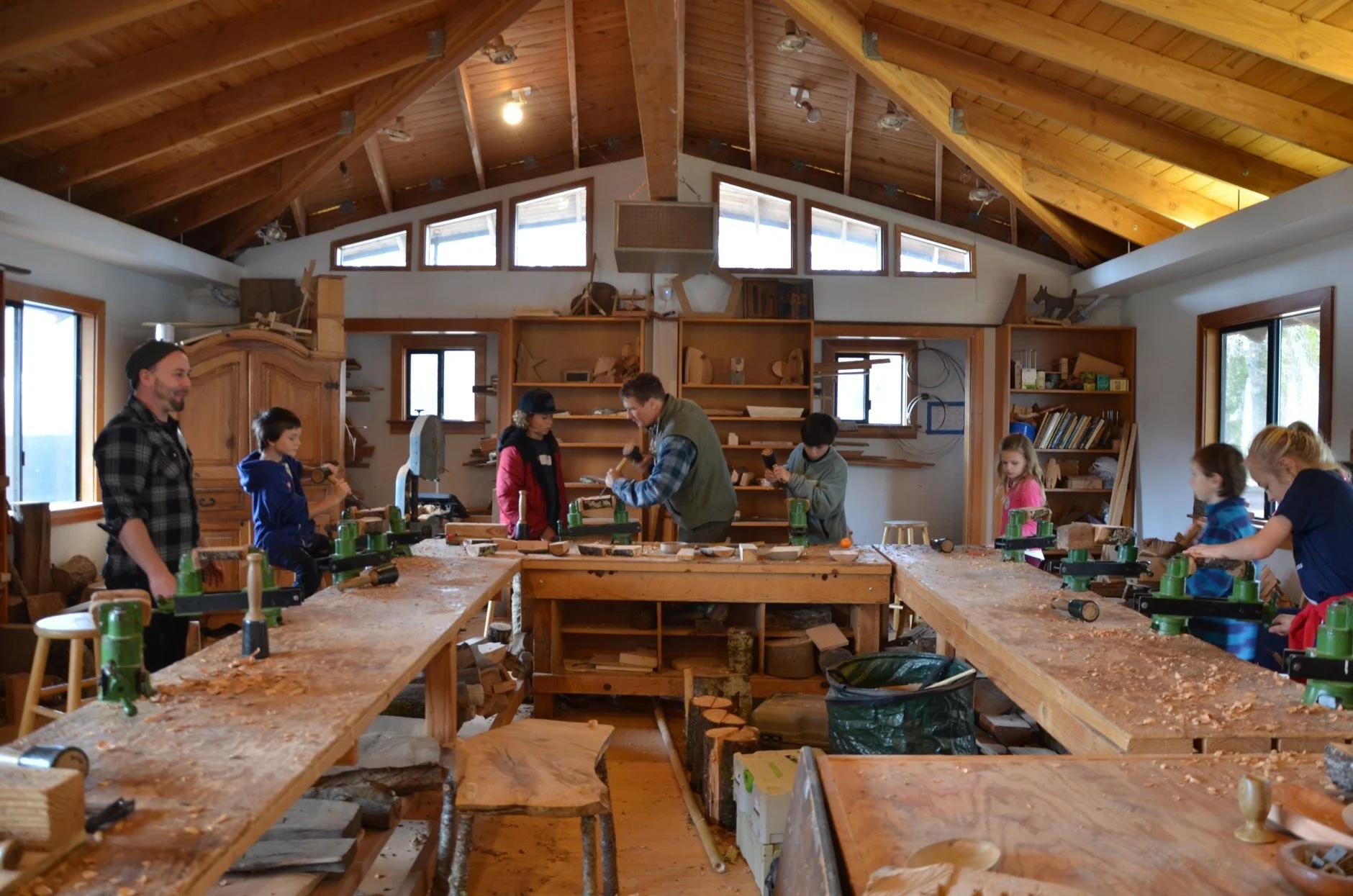
In fourth grade, a beloved block is dedicated to humans and animals, culminating in an animal report, researched, authored, and presented to the class by each student. Here’s how fourth grade class teacher Ms. Ashley describes it:
The Human and Animal block is taught in two three-week blocks, once in the fall and once again in the spring. The students lessons are filled with lots of information on the Goethean phenomenological approach to zoology that is the basis for the animal studies.
During the last block the class learned note taking, writing short paragraphs, and drawing pictures of the animals they heard about in Morning Lesson. Together, the class created an octopus garden diorama in class prior to the presentation. It culminates with the student presenting an animal report, drawings, and diorama of the animal of their choice and presentation to the class.
Below, enjoy a few photos of the dioramas that students made of animals in their natural habitat.
Meet Adam Neale, Mentor and Maker
Adam Neale, Marin Waldorf School’s woodwork and outdoor education teacher, has always had a fondness for making things. He brought that gift, along with his genuine kindness and affability, to Marin Waldorf School over a decade ago, and today is one of the most beloved teachers on campus. An outdoor enthusiast and sportsman, he is a veteran of many MWS class trips, as well as an alumni parent and father to twin girls.

In the interview below, Mr. Neale tells us about his childhood in Miami, first-day jitters as the new MWS woodwork teacher, and (as you hoped!) how he met his wife, MWS director Megan Neale.
Young Adam Neale working on his sassafras stick.
What was your childhood like?
I grew up in Miami, Florida. I loved it. I was really into the natural world, being outside all the time, being on the water, in the woods, in the mangrove swamps. That’s where I loved to spend my time.
My parents really enjoy being outside too. My mom studied marine biology. My dad was into fishing. They loved bird-watching. We spent our weekends out and about.
I’ve always liked making things. One of my first memories of woodworking was from summer camp in North Carolina. We dug up these little sassafras trees and I made a cane with the wood. I spent so much time working on that walking stick—and it’s funny to think it’s the same thing I do today, something that I was really drawn to as a child. Now I work surrounded by all these sticks! It’s endless what you can do with that stuff.
I went to a high school that had a week in the wintertime where you could take a class and make things, it was called Intersession. I made a fishing rod. There was a teacher and a fisherman, and he had kits for putting the guides on a rod. I never forgot that either.
You’re into fishing too, right?
Yeah, I’m into fishing too. I just made another fishing rod during the pandemic. I tie my own flies.
Adam Neale and Megan Neale in 1990.
How did you find your way from Florida to California? Were there stops in between?
I met Megan at a wedding in LA. She had decided that she wanted to live in Miami before I met her. I was living in Phoenix, Arizona, at the time. I told her I needed a ride from Phoenix to Miami to visit my parents—because I liked her. She was living in Marin and had just graduated from UC Santa Barbara, and she came through Phoenix to pick me up on the way to Miami. Our first date was driving across the country.
Later, she got into graduate school in Colorado. I ended up going with her, and it changed my life in a big way. I thought I would live in Miami forever. And then I was the Florida guy who moved to the mountains! I’d seen snow one time before I moved to Colorado. It was freezing cold.
I got a construction job with a really good carpenter who took the time to show me how to use tools and really do things right. I was grateful for that. Megan was a junior high teacher. Later I taught snowboarding, I taught fly fishing, and I was a raft guide.
Canoeing in North Carolina as a teen.
Were these your first teaching jobs?
I actually started to teach at the camp where I got into woodworking. I was a camp counselor there, and I taught canoeing and whitewater rafting. So I had quite a bit of experience teaching kids at that point. I had really good mentors, people who taught me, so it was easy to teach what they had showed me.
We bought a house, and then we had twin daughters. That’s when we decided we needed to be around family, so we moved here.
How did you end up at Marin Waldorf School?
I was looking to get back into surfing, and I went to see a surfboard for sale at someone’s house. His wife ran a Waldorf preschool from their home, and their daughter went to Marin Waldorf School—she was a few years older than our daughters. Our daughters were just about the right age to start preschool, so they started going there, and we became very interested in Waldorf education.
When our daughters started at Marin Waldorf School, I was doing construction, working with a friend. The woodworking teacher’s daughter was in the same class as my daughters, and we were good friends. I would help him out in class sometimes. A few years later, the next woodworking teacher left unexpectedly and the school asked if I wanted to take the class. I said sure! I jumped in midyear.
Was it challenging?
Very! I’ll never forget the first day—I don’t think I’ve ever been so nervous in my life. I was nervous for so long—even on the outdoor ed hikes! I felt a lot of responsibility. What am I going to teach these kids? The people here are so bright, there’s such a high standard, so I felt I had to live up to that. [Current 8th grade teacher] Ms. Deason was our class teacher, so that was the standard that had been set.
My daughters were in fifth grade when I took the woodworking position, and that’s the first year of woodworking in the curriculum, so I taught my own daughters. I think I overcompensated by ignoring them. And they felt weird calling me “Dad,” so they called me “Mr. Neale.” Hearing “Mr. Neale” in their voices was always funny. But it was great. They’re very easy-going.
It’s surprising that you were nervous because you have a good, natural connection with the kids.
It’s an interesting position I’m in because the students have something in front of them that they’re working on. I give them the space to create stuff, and I get out of the way. They are very open. A lot of conversation comes naturally in that space.
Let’s talk about outdoor education, which you also teach.
That’s another place where I’m creating space, trying to help the kids feel comfortable outside. That’s my main goal: to connect them.
I got a degree in environmental studies. It was a bachelor of arts degree, so I studied a lot of philosophy behind the environmental movement. I always wanted to affect change for the environment, but I always wanted to do it on an individual level. I felt that was more my style, because I have a peacemaker side to my personality, where I connect with people and I want to understand them. So my idea was to be an outdoor educator to connect kids to the environment so they, in turn, would want to do the right thing for the planet.
That’s what I feel the Marin Waldorf School outdoor education program is about. Number one, making kids feel comfortable outside, so they want to go outside, so they see the value of it, without telling them that directly. There’s another word for it: coyote mentoring. In this philosophy, you’re bringing kids along but not telling them exactly what you’re doing—by playing games, having moments where you go outside and try to be as quiet as you can to listen to the birds—but what you’re teaching them is how to be self-reflective. Once they get quiet, they start to notice things about themselves while they’re trying to notice things outside. Trying to do that with young teenagers is really a challenge.
We’re so blessed to be surrounded by open space here. Trying to imagine what ancestors, what native people, the people who were here a long time ago were doing and connecting with that as well.
What about class trips?
Again, it’s that experiential education. It was a big part of my education growing up—I learned most by doing—and I traveled a bunch when I got out of school. I always pushed myself on those trips. Academics are important, but putting that to practical use, seeing the skills they developed in the classroom and the social fabric that they have, then they get to go out into the world. I’ve heard a lot of different compliments from hosts for our groups who say, these kids are just amazing.
The first five or six years, I never went on any trips. I went as a parent. But slowly, once my girls graduated, I start going on class trips. Iv’e been to Hawaii with Kathy Darcy’s class—that was an incredible trip. I went to Colorado, Arizona, the Four Corners area twice. I did the Eel River with Gail. They all were special. I went to Boston with Ms. Jackson.
There are so many moments I remember, like traveling across the country on a train with Rising’s class and watching the kids interact with the conductor. It was so neat to see kids who were so polite and who weren’t afraid to put themselves out there and talk to people.
Any trips in particular that stand out?
It’s hard to say. Every one! I’ve been so lucky.
Igniting Curiosity in Middle School Science
A spirit of inquiry, experiential learning, and an integration of academic disciplines are cornerstones of our school’s approach to education.
In our middle school classrooms, where 6th, 7th, and 8th graders explore complex topics in chemistry, physics, physiology, biology, and geology, science isn’t presented in concepts and lectures. It begins with observation. Through observation, our students learn to think like scientists, asking questions and posing theories before being given all the answers.
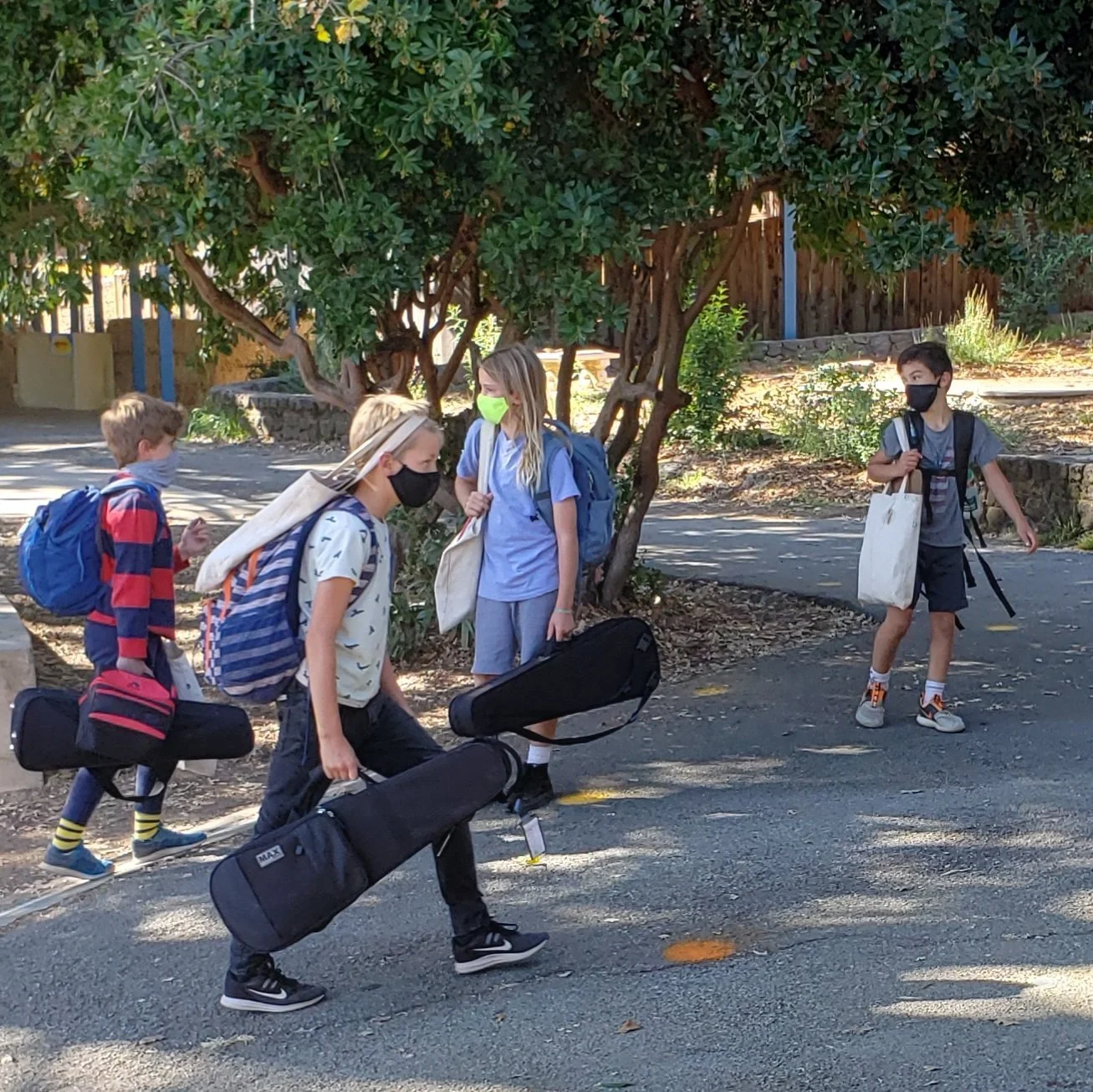
A spirit of inquiry, experiential learning, and an integration of academic disciplines are cornerstones of our school’s approach to education.
In our middle school classrooms, where 6th, 7th, and 8th graders explore complex topics in chemistry, physics, physiology, biology, and geology, science isn’t presented in concepts and lectures. It begins with observation. Through observation, our students learn to think like scientists, asking questions and posing theories before being given all the answers.
Even art, which is integrated throughout our curriculum, is used as a tool for understanding STEM topics. For example, in their studies of combustion as part of the 7th grade chemistry block, students were asked to observe and then draw a bonfire and a candle. You can see a few examples of our students’ work below.
As a capstone to the study of combustion, teacher Ms. Terziev performed a demonstration for the class, asking them to watch silently and then offer their theories on what they’d observed.
After watching the experiment, students brought their questions and theories to the group, inspiring both curiosity and critical thinking in the classroom. This approach helps students build a meaningful understanding of complex scientific concepts. In Waldorf education, this is called a phenomenological approach to science. In this way, 7th graders at Marin Waldorf School connect and internalize complex topics in chemistry, like combustion, as well as crystallization, acids/bases, and the lime cycle.
The study of science at Marin Waldorf School begins in early childhood, with the simple observation of the seasons and the natural world, and through nature stories. In elementary school, students learn to ask questions and to learn through doing, laying the groundwork for more complex critical thinking that they will need to tackle their studies of chemistry, biology, physiology, geology, and physics in middle school.
This blog post is part of a series from our Grandmother Oak Blog. To read more posts like this one, visit grandmotheroak.org.
Strings Outdoors & the MWS Music Program
Music is an essential part of the curriculum at Marin Waldorf School. Throughout the day, children in the preschool and kindergarten sing with teachers and classmates, learning not only the songs but how to listen and to work together as a group.
In the sculptural, pictorial realm we look at beauty, we live it, whereas in the musical realm we ourselves become beauty. In music man himself is creator. he creates something that does not come from what is already there, but lays a foundation and a firm ground for what is to arise in the future.
—Rudolf Steiner, Practical Advice to Teachers
Music is an essential part of the curriculum at Marin Waldorf School. Throughout the day, children in the preschool and kindergarten sing with teachers and classmates, learning not only the songs but how to listen and to work together as a group.
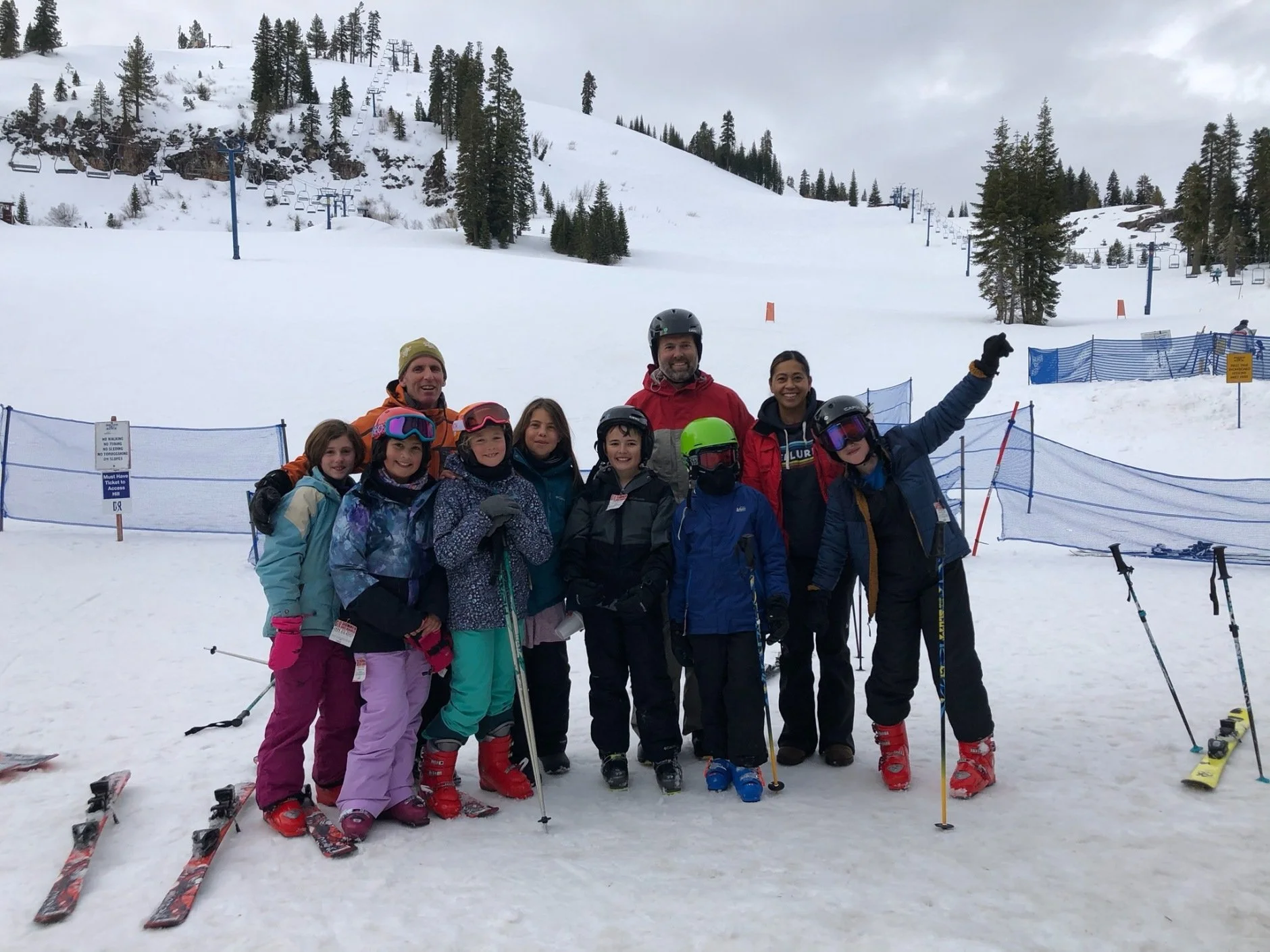
In the grades, students begin to study instruments, starting with flutes in first and second grade. In fourth, all students begin studying violin, with some choosing to take lessons on other strings or orchestral instruments. By seventh and eighth grade, the class has become an orchestral ensemble, with opportunities to perform for their parents and the greater community at various concerts throughout the year.
Like everything else, our music programs have been adapted this year. Students and teachers are getting used to singing (and performing!) with masks on, while our orchestra teachers test out the acoustics in the breezeways and amphitheaters (our strings program will be entirely outdoors this year!). Still, there are some upsides to the new arrangements. For one thing, we’ve been hearing our students perform a lot more frequently as we listen to classes practicing outdoors, throughout our campus grounds. Take a look …
Here is the second grade practicing flute in their outdoor classrooms.
Under the protection of the outdoor breezeway, new fourth grade violinist practice strings basics with their teachers Ms. Stewart and Ms. Eldridge.
By 8th grade, students have progressed immensely, with many taking up other orchestral instruments, like cello and flute, to complete their ensemble. Here’s the class of 2021 playing for the class of 2022 in the amphitheater.
In closing, we are delighted to share this video of our students in grades 4-8 performing at the end of the fall semester. Here, you’ll see how the class ensembles progress over their years of study… and enjoy a glimpse of what we’ve been practicing on campus.
You can read more about music in the Waldorf curriculum in volume 18 of Renewal, the magazine published by the Association of Waldorf Schools of North America, as well as at the informative website Waldorf Music.
Meet Adam Stopeck: Philosopher, Singer, Skier, Sixth-Grade Teacher
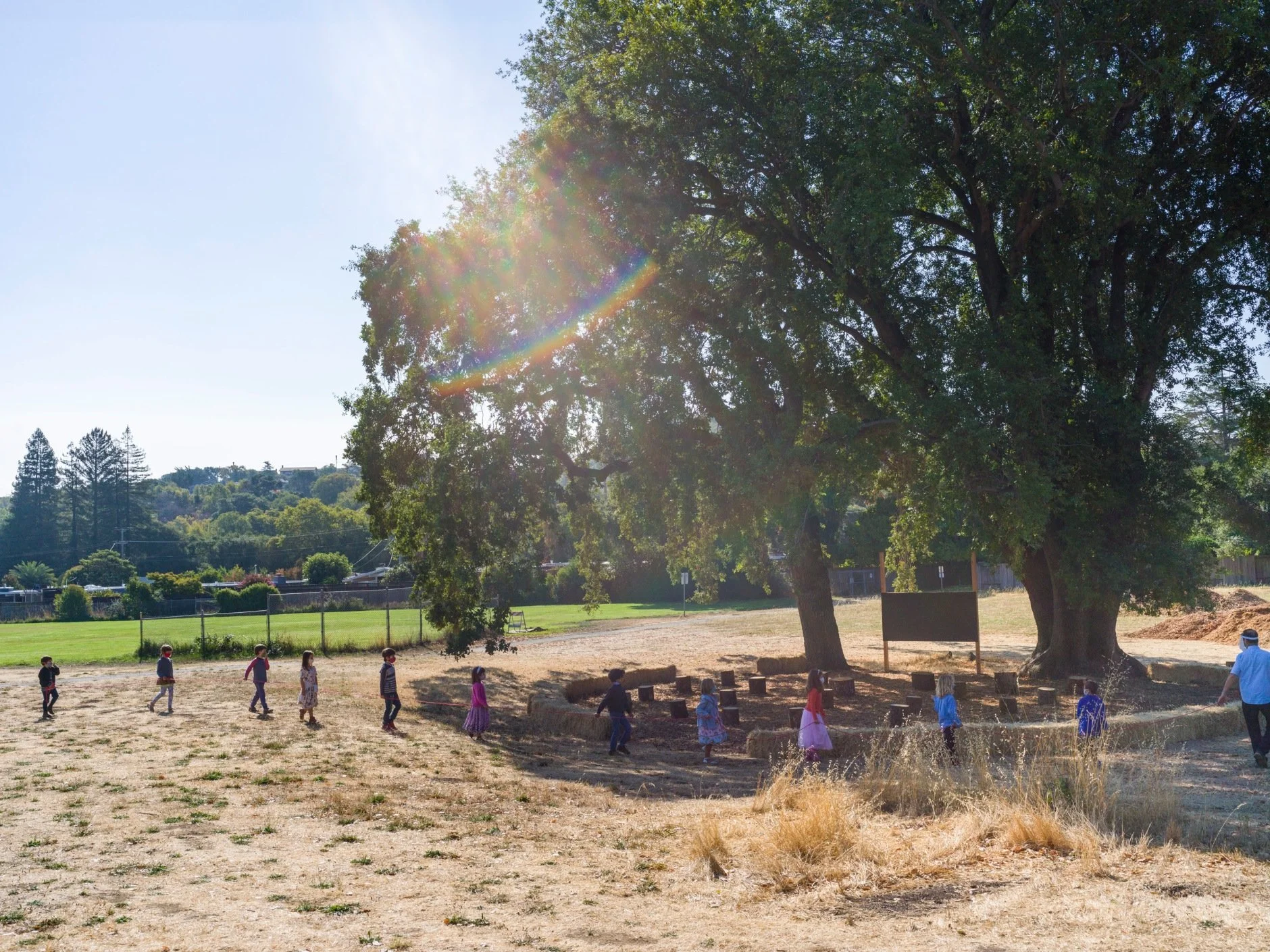
A native East Coaster, Adam Stopeck met his life’s calling as a Waldorf teacher (and his future wife!) on a chair lift in Colorado. He joined MWS last year after decades as a class teacher in Carbondale, Colorado, and Vancouver Island, British Columbia, taking the lead in our now-6th-grade class. Read about his early days as a basketball aficionado, ski bum, and would-be Socrates, and what he loves about teaching the grades in the interview below.
Tell me a little bit about your background.
I was born and raised in Oceanside, Long Island. My mom was a piano teacher for five decades, and I’m sure that’s where the teaching gene came from.
Did you play the piano?
I did play the piano, but I was more drawn to playing basketball. In a very un-Waldorf way, I didn’t think I could do both. It was a very traumatic day for my mom the day I gave up the piano.
What’s Oceanside like?
Classic, uninteresting suburbia but it was only ten miles from the beach. Those were some of my fondest memories as a young child, endless days playing at the beach. Much of my early adolescence was filled with playing sports with the neighborhood kids. When I was 14, I went skiing for the first time in upstate New York and I was hooked. After a family ski trip to Colorado, I knew I wanted to go to college in Colorado and I eventually wound up at the University of Colorado at Boulder.
What was your experience like in university?
I really thought I was going to ski a lot but it was expensive, crowded, and difficult to get to the mountains. What I really became enamored with was philosophy. I really thought I was a young Socrates, going around most of the day asking people, “Let me ask you a question?” My great quest for knowledge and wisdom eventually landed me on a ski lift in Aspen, Colorado, where my life took a dramatic turn. After ten year of “ski bumming” in Aspen as a ski instructor, ski patroller, bike guide and, of course, dishwasher, I met my future wife. Where else but on a chairlift!
By some strange happenstance, she was the first grade teacher and one of the founding teachers at the Aspen Waldorf School. We began dating and she started inviting me to lectures at the school. Eventually I listened to a lecture by Eugene Schwartz and he said that “Waldorf education is a revolution in education.”
The word revolution sparked something laying dormant in me from my “angry young radical” college days. A week later, after ten years of living in the mountains, I suddenly found myself in Sacramento, doing Eurythmy at the Rudolf Steiner College. That was a shock! I eventually wound up doing a three-year, full-time teacher training. My now-wife came out and joined me and we supported our Rudolf Steiner college habit by running the food program there.
Did you begin teaching right after that?
By that time, the Aspen Waldorf School had moved down the valley to Carbondale. Now it’s the Waldorf School on the Roaring Fork, and that was the first place I taught. We were there for close to a decade.
Later, when I had three young children—they were 4, 3, and 2—we had this crazy idea, “Maybe we should move to a foreign country and teach at a Waldorf school ?” After pipe-dreaming about Switzerland and Germany, we moved to British Columbia, Canada and settled on Vancouver Island. My wife and I were both Waldorf class teachers at the Sunrise Waldorf School in Duncan, British Columbia. It was an amazing place for the kids to grow up. They spent countless hours romping around the woods, climbing trees and swimming in the endless lakes and rivers.
In B. C., I took a class from 1 to 8, which was something I had always wanted to do. It was an incredible journey. Taking a class 1 to 8 is not for the feint of heart. I really believe that for it to happen in a meaningful way, the stars need to align for the teacher and the students. Maybe even more so for the teacher and the parents!
How did you end up in the Bay Area?
After I graduated my 8th grade class, I took a first and second grade. But we really wanted a Waldorf high school for the kids, so we moved here. They all went to Credo. That brought us back to the U.S. after a decade in Canada.
Are all your kids still in the area?
My youngest son is a senior at Credo. My oldest son and middle child, is a sophomore at La Verne University in LA and my daughter is a sophomore at Quest University in Canada. My wife still teaches part time, as a painting teacher to high school students and adults at Credo, as well as her full time job, as a Chocolatier.
When you graduate your 8th graders in a couple of years, and your son graduates from Credo, what’s next? Are you off to a new adventure?
“I’ve been everywhere” like Johnny Cash says. But I am really enjoying my time at MWS and absolutely adore my class. I also love teaching the younger grades, so I can really see myself teaching grade one again. After I graduated my 8th grade class, I went immediately back into the first grade. At first, I wondered how was I going to go from the heights of grade eight back to class on. In grade eight you feel like you’re at the top of the mountain—you just performed a Shakespeare play after all!
Mr. Stopeck leads the 6th Grade class in a pre-Halloween.
At first it was really hard. But then I realized the incredible amount of freedom you have during a first grade morning lesson. With Shakespeare you’re limited by the script. In a first grade circle, you have this incredible opportunity to create the entire script. It really showed me the joy of this whole process. You can get excited about every grade. It doesn’t matter what you’re teaching, whether it’s math or grammar, you have to somehow enliven it. How do you bring grammar in a lively way in grade 1 and grade 8?
You have to totally transform yourself from the young ones to the older grades but the impulse of creativity is the same. It is this element of creativity that runs through the whole education, that brings so much vitality to the experience. As a teacher, your truly creative moments are what the students respond to. For me, it is in these moments that teaching becomes a joy.
Interview by Julie Meade. This interview has been edited and condensed for clarity.
A Look Back, in Gratitude, at Our Autumn Season
Our extraordinary autumn began with power tools and wheelbarrows, hammers and hard work, as faculty, students, parents, and staff came together in small groups to construct our outdoor classrooms. Right before campus opened, we were joined by two members of the Miwok tribal council to talk about the land and prepare the campus to receive our students.
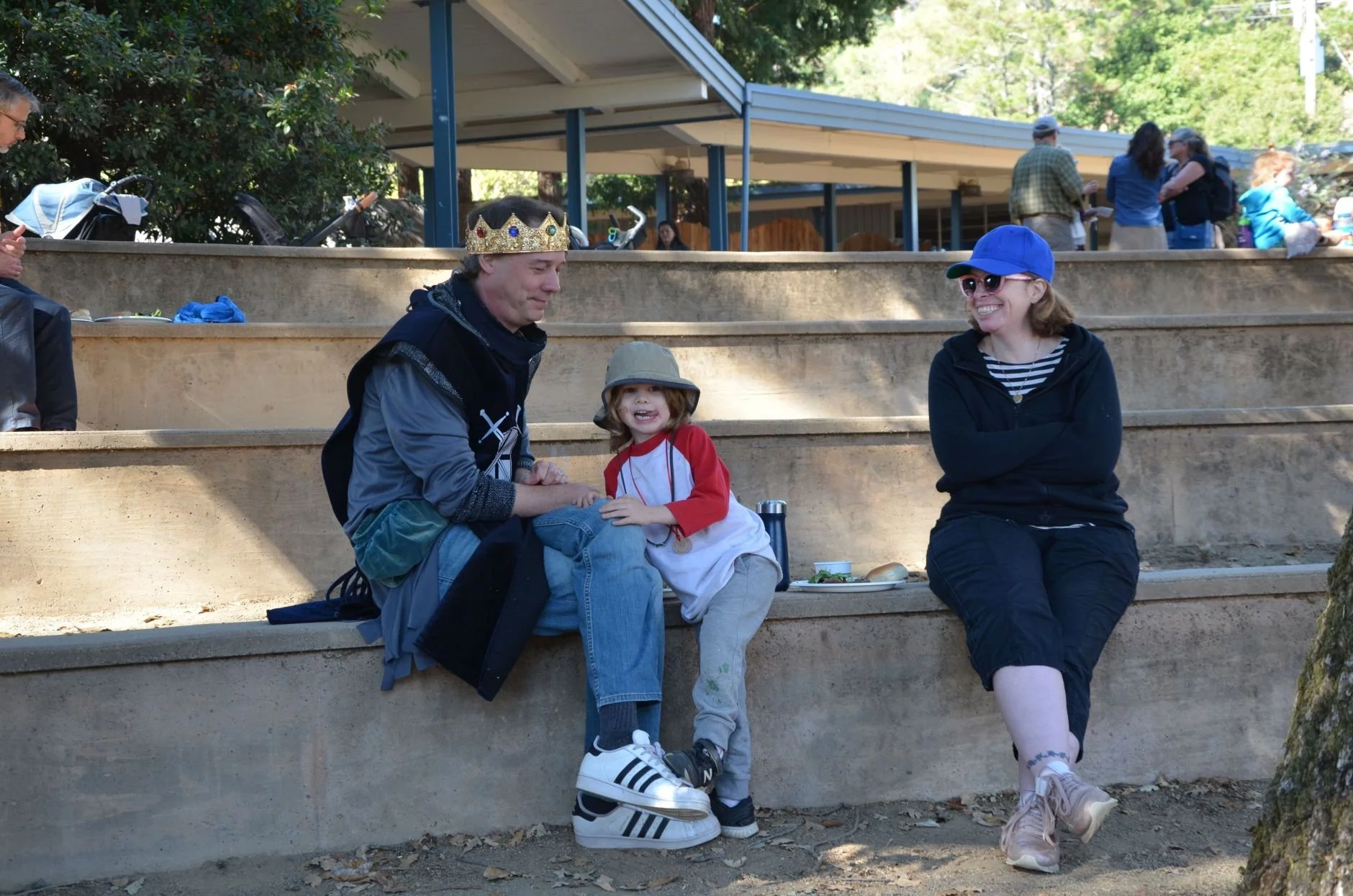
On September 8, our preschool and kindergarten reopened with a new mixed-age model and a fifth classroom called Manzanita. Lots of time outdoors, plus our staple weekly hikes to the open space, made this year memorable.
Grades 1-6 also came back on September 8, and their learning began atop stumps and hay bales, nestled beneath the oaks and bay laurels. Two weeks later, our 7th and 8th graders joined us. We hiked to open space, observed the change of the season, and found monarch caterpillars in the Peace Garden milkweed.
An AQI-related closure postponed our Michaelmas celebration, but the dragon still came out the following week, with students watching each other’s performances from a distance.
The week before Halloween, children carved pumpkins in early childhood and the grades, and the 6th grade dressed up in pirate garb to serenade our school with a seafaring song.
The following week, Maestra Pineda guided the 7th and 8th grade students in creating a traditional altar in observance of the Mexican holiday Dia de Muertos. Read Maestra Pineda’s description of the holiday or see more photos of the altar here.
And the two classes united that day to sing “Ishe Oluwa,” a song of the Yoruba people in West Africa.
We continued our work in examining our school curriculum and community through the lens of diversity, equity, and inclusion.
And now, heading into the holiday week, we are feeling nothing but gratitude for being surrounded by the oaks and laurels, the great big sky, and our wonderful community.
Meet Adventure-Loving Marieke
A native of the Netherlands and a graduate of the Waldorf teacher training program in Stuttgart, Germany, Marieke Duijneveld joined the MWS family two years ago as a mom to four students before taking a place on our faculty last year as a parent-child teacher. In the fall of 2020, Marieke took the lead in the Morning Glory kindergarten class, where she leads twice-weekly song-filled play-based hikes in the hills around school. Read on to hear how Marieke’s free spirit and a love for adventure has propelled her across the world and all the way to Marin County.
Tell me a little bit about your background. Where are you from and where did you grow up?
I am from the Netherlands, from a little town close to the coast—right near the polders, or reclaimed land. In the Netherlands, a lot of the land is created, because it’s below sea level, so they pump the water out and create land.
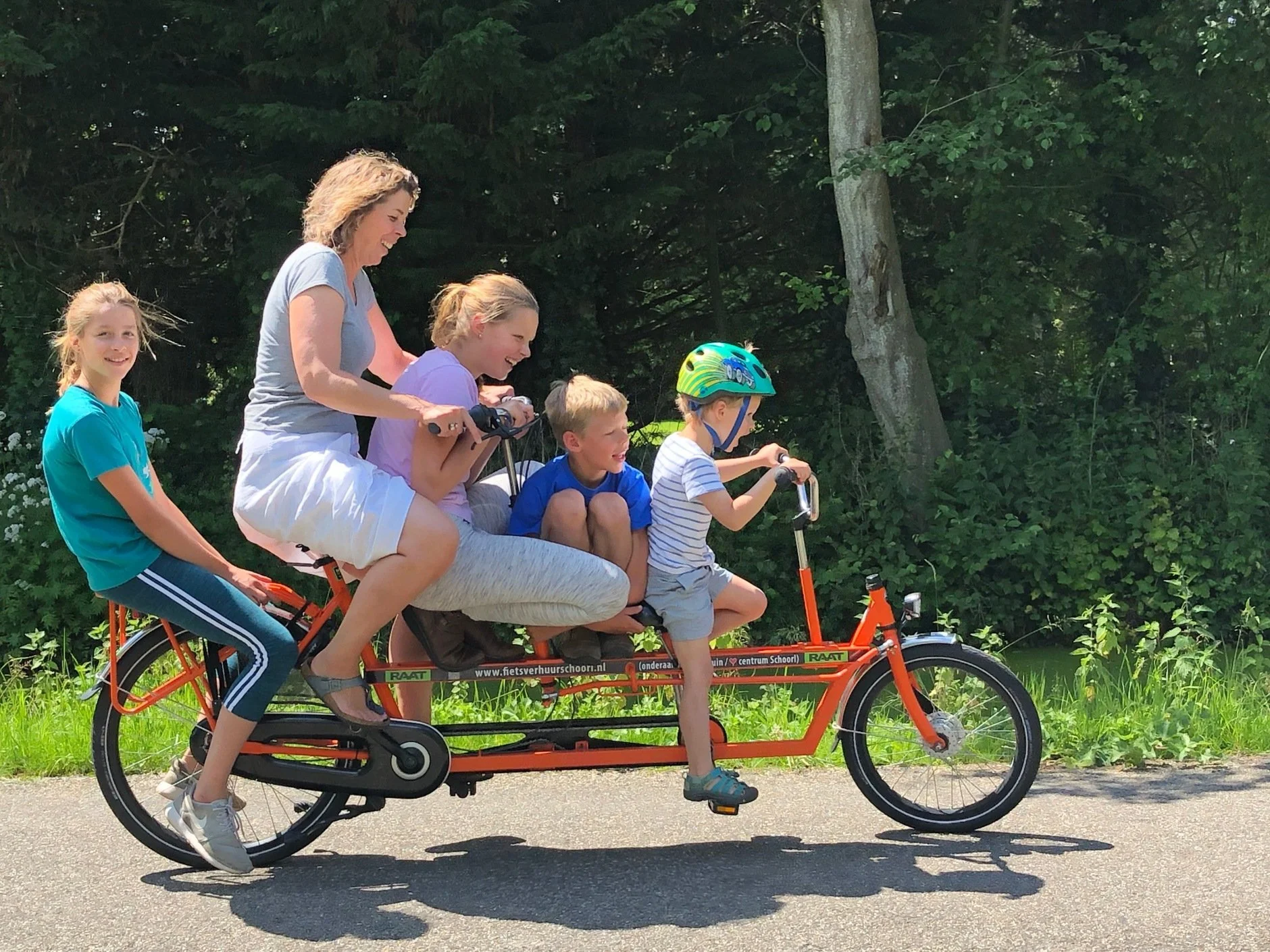
My father was a teacher in a public school, but when I was two, he became a Waldorf teacher. I went to a Waldorf school from preschool through 12th grade. We biked to school every day. We used the car to go on vacation or to visit my grandparents, who lived two hours away, but we never used it for school—only on my birthday! That was very special, because on my birthday my mother baked a treat to share with the other children in my class, and so we had to drive to school to bring it. Otherwise, rain, shine, snow, we always biked.
I was a very dreamy child. I had a vivid imagination. I would go into the woods with my friends in long dresses without shoes. I always dreamed of traveling, my ideal was with a covered wagon pulled by a donkey.
Did you imagine yourself being a teacher growing up?
Not at all, because both my parents were teachers, and they taught at the school I went to. I thought I’d never be in that same situation with my own children!
And now you work at the school where your children go!
Well, at least I don’t teach them.
What did you parents teach?
My father was a class teacher—but in the Netherlands, there aren’t many subject teachers, so the class teacher also teaches subjects, like form drawing, music, English, German, gym. My mom was the woodwork teacher.
When I was 16, my father took his sabbatical and we moved to Sweden for a year where we lived on a farm with adults with special needs. I went to a school that wasn’t a Waldorf school. It was a huge shock! But it was good for me, and helped me to appreciate Waldorf education.
Then you went back and graduated from the Waldorf school?
Yes, and then I went to college and I met my husband while in college. We were in the students’ choir, and one weekend we were all on the train and someone found out I went to a Waldorf school.
He called to Jasper, “Hey, Marieke, also went to Waldorf school!” So we sat together and talked about woolen underwear and no TV, and so on, and that was it!
How did you end up in California?
When we were both 28, we wanted to move abroad. I had a dream: Let’s start an orphanage in Argentina! I was looking for something adventurous—something that sounded very far away. My husband is a bit more realistic. A friend of his worked at Weleda and it’s an international company, so Jasper applied to Weleda, and was hired in a role in Germany. Moving to Germany did not feel as adventurous as Argentina. And there were no palm trees!
Since we’d moved to Stuttgart, I decided to attend the Waldorf teacher training. I didn’t speak German very well, so I needed to find something to help me learn the language. I loved it. I studied to be a class teacher, and I taught in a local Waldorf school after graduating. Then our first daughter was born, and our second daughter soon after that.
When Jasper was asked to lead Weleda North America, we had to decide whether we would move to the United States. At first, it didn’t sound appealing to me. But we both like adventure, so we said, let’s do it and see what happens. We moved to Chestnut Ridge, New York, a little north of New York City.
We loved it there. I didn’t know much about the U.S., and the people were so helpful and so nice. It was nice to live close to New York City, because we could just go there for a night, for instance to Carnegie Hall. We loved the Waldorf school our children went to. In the Netherlands, all Waldorf schools are public charter schools, none of them are fully independent, private schools. So children have to take tests and the curriculum is heavily influenced by the public school system. The education at Green Meadow Waldorf School in Chestnut Ridge felt so much closer to what I think Steiner intended with Waldorf education.
I worked as a parent and child teacher, and later as a kindergarten teacher at Green Meadow Waldorf School. After a total of 10 years in New York, it was time for something new. I still missed those palm trees and wanted to go to California. So we chose to move across the country and embrace yet another adventure here in Marin!
Tell me about being a mom to four children. That’s a lot of kids!
Yes it is a lot. And I love it!
I always wished for a large family and am so grateful to have four wonderful children. There is an anecdote about how to deal with a large family. With one child, both parents have their hands full, with two, it’s really, really busy but at least you have two hands, and in my case a partner. Three is stressful because you’re trying to stay in control, with four you just have to give up trying to keep everything under control.
Working with children in kindergarten every day inspires me to be a better mom. And vice versa, my experience as a mom probably also helps me professionally.
Kindergarten is different this year, but are there any upsides to early childhood during COVID?
It is wonderful to be outdoors more than before. We added more hike days to the program, which I otherwise maybe wouldn’t have done. Being on these hikes in nature with the children is so sweet. We go to places where there aren’t any toys, and they just play! They play for an hour and a half without taking a break, and they enjoy being in their dreamy worlds.
It’s lovely to be in kindergarten and to help create a world that is good, and forget about everything else that is going on.
Also, I love that the groups are smaller as a result of the Covid pandemic. It seems to benefit the children socially. It feels more natural.
Meet the Globe-Circling Sally Li
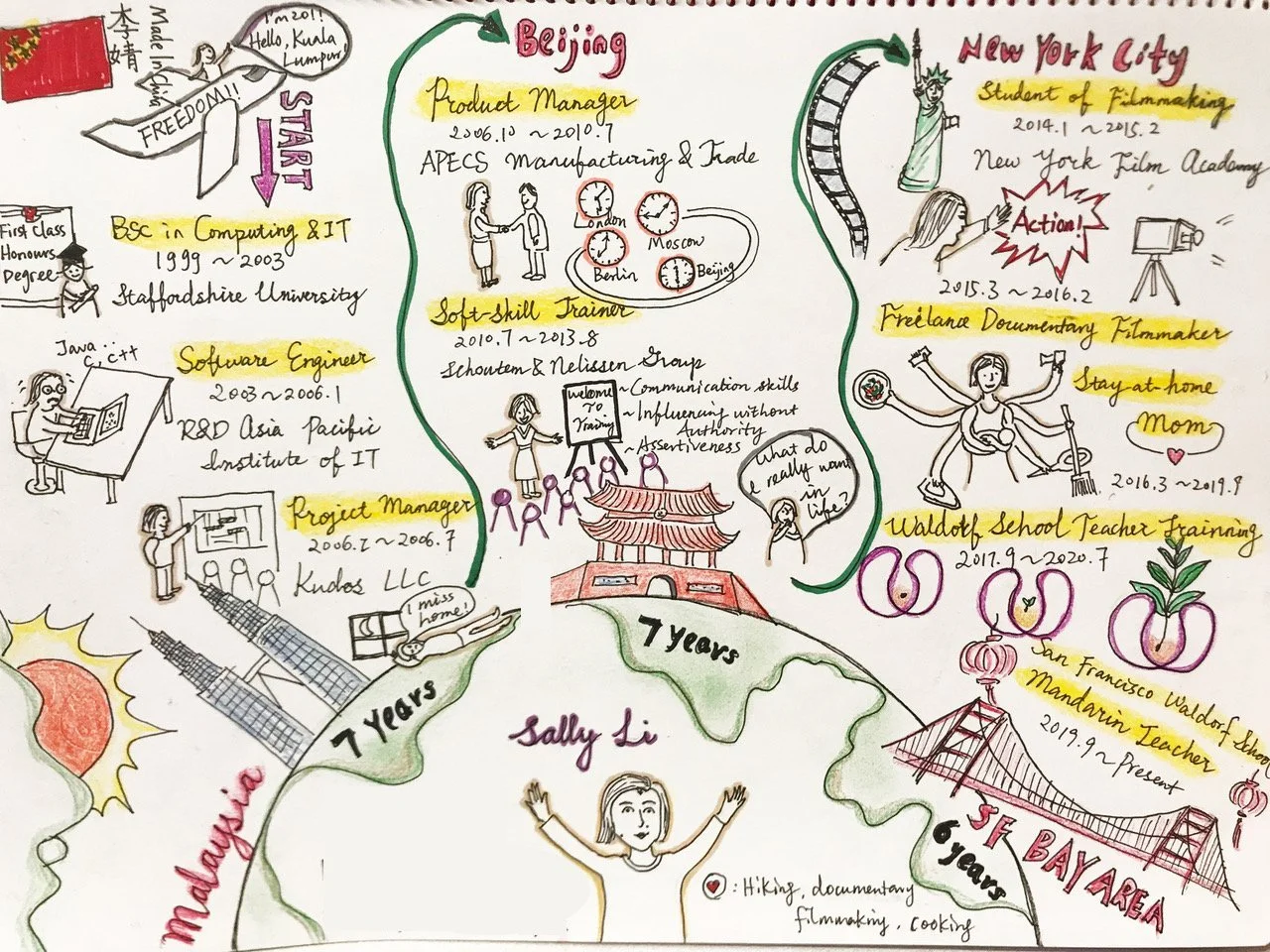
Raised in Zhangzhou City, China, Sally Li has followed her heart around the globe and through diverse careers before she joined the faculty at Marin Waldorf School this fall, where she currently teaches Mandarin to grades 2, 3, 4, and 5.
“I don’t know how I make my decisions,” Sally says. “I just feel it. Something is calling me.” Those instincts brought her to Malaysia at age 20, prompted her to leave her corporate job in Beijing to pursue a career in filmmaking, and eventually led her to Waldorf education. Read about it all (and see her short film!) below.
Sally, we’re so glad you’ve been called here!
Tell me a little bit about your background. Where are you from and what was your childhood like?
I’m from Zhangzhou City. It’s in the middle part of China. I have some friends who say it’s like Nebraska.
My childhood was really free. In China, at that time, in my surroundings, moms tended to be very controlling and always focused on academics. My mom wasn’t like that. She trusted me. I could play with boys and I loved adventure. I was a wild little girl.
We lived in a huge military compound and my dad was a teacher at the academy. There were people there from all across China, and they spoke many different dialects. I grew up in that type of inclusive surrounding, where people speak different languages but we are all neighbors.
When I was 20, I moved to Malaysia.
What brought you to Malaysia?
A lot of my decision-making is very ad hoc. I was studying hospitality at the university. A Crown Hotel and a Holiday Inn had just opened in the city, and they went to my university to pick a few students who would work in their hotels after graduation. I was one of the two who were selected. My parents were super happy! I had a job already, even though I was still in school!
One day I was riding my bike and I rode past a storefront that said something like, “Go Overseas!” I went in, they told me what they did, gave me some options of where I might go. The next day I brought my dad there with me and told him, “I’m interested in this.” That was the beginning.
My dad had a friend whose daughter wanted to go to Malaysia, but she was introverted. She didn’t want to go alone. My dad said, “Why don’t you take a break for the summer and go with her to Malaysia?” After that, there was no return. I came back to China and said, “I’m not going to take that job. I’m going back to Malaysia.” I really liked the tropical weather and the blue sky, and everything was new. It was mind-blowing.
Seven years later I went back to Beijing for a project assigned by the company I was working for in Malaysia. I fell in love with Beijing all over again. I decided to come back to China. I was in Beijing for 6 or 7 years. At that time, I was doing soft-skill training, teaching corporate people how to communicate, how to influence without authority, leadership skills, and so on.
One day I was training a bunch of IT people on how to ask powerful questions. I used myself as a real case scenario. I told them I felt a little bit stagnant in my job and I wondered if there was anything else I could do with my life. There was just a tiny little bit of feeling in me. I still loved that job. I just brought myself as a case for them to practice on. I wasn’t expecting anything.
They asked me, “What is the thing you always wanted to do but you never had the chance?” I said, “Be a movie maker!”
The next question was: “What was the last movie that you watched that inspired you?” I told them Life of Pi.
They asked, “What do you like about that movie?” I said, “I like the feeling when he encounters the tiger. At that moment, I felt very connected to the movie.”
The next question came in. “What is the tiger in your life? The thing that makes you feel excited and also a little scared?” I said, “That’s a great question! I think being a moviemaker is the thing that makes me feel most sharply alive.”
I took one month off my job. I went to Beijing Film Academy to do a workshop led by the New York Film Academy. After that, I quit my job and I went to New York.
To New York City?
Yes, I went to New York City for a year to study fiction filmmaking. I learned the skills, but I wasn’t drawn to narrative filmmaking. I found I was more interested in documentary. I told my teacher, but it was too late to change course. It was a two-year program. For the final project, everyone made their narrative films and I did a documentary anyway, and many people were touched by it.
What was the film about?
It’s about mystical coincidences. It’s about 15 minutes.
Around that time, a friend invited me to San Francisco to film the experience of a tour group that focuses on spiritual learning. I fell in love with San Francisco! So then I came here. I got married, had a son, and when my son was 9 months old, I felt very disconnected. I almost went into depression. I thought, I need to save myself. I need something that connects me to myself. I emptied myself and I couldn’t feel myself anymore.
I had a feeling it had to be something to do with education, because I’d just had a boy and I wanted to be a good mom as well. I found Waldorf Teacher Training. I went to the three-day Visiting Day program and after the first day I said, “I’m enrolled!” Life changed again, for the better. The teacher training really helped me to reconnect with myself.
How does it feel being a new teacher?
The hardest thing isn’t the content, it’s classroom management! I started teaching at the San Francisco Waldorf School, with the 2nd grade and the 6th grade. Even though they are just a few years apart, they are a very different group.
I started handing out questionnaires—asking what kind of pets do you have, how many siblings do you have, what are you most scares you. I wanted to build a relationship. I want them to know that they can trust me and this is going to be fun. That act alone made them feel that their teacher wanted to know about it—and then they were really into Mandarin! (Below, see some of the beautiful work Sally’s students created at San Francisco Waldorf School.)
Chinese idiom: ma ma hu hu
Chinese story drawing
Now I’m starting at Marin Waldorf and I’m learning more every day. I just love it. The students bring me so many surprises. Sometimes, I take ideas from students in one class and apply it to another class. It’s not coming from me. I’m just a carrier!
Tell me a little bit about the things you teach, and how you build a connection to Chinese culture.
The first class I had with them, I brought pictures to help create more connection to China. You never know who has a connection to what—food, Kung Fu, panda. I did a puppet show for 2nd, 3rd, and 4th grade. I received so many compliments from the students. I’m still exploring new and different ways to teach. I see them having a good connection with me. They are learning! There are still things I want to improve. I want to make my lesson more beautiful.
Pandas by Sally Li’s students at Marin Waldorf School.
I’m going to bring more Chinese literature and storytelling to the class. I’m preparing The Monkey King’s Journey to the West—it’s a spiritual journey, in a way, a Chinese version of the Odyssey. And later we’ll bring more ancient idiom stories. Which is super fun! Because they have to draw the character. Like “the pot calling the kettle black.” Each four-character phrase has an ancient story behind it. I did it with the 6th grade at San Francisco Waldorf School and they loved it. That can create beauty!
Interview by Julie Meade. This interview has been edited and condensed for clarity.
Meet the Imaginative Rod DeRienzo
In the second installment of our interview series, we’re introducing the delightful Manzanita early childhood assistant teacher Rod DeRienzo. Mr. Rod is known to many children on our campus as the famous voice of the Gold Monkey and Jeremy the Giant, two characters from an original story series he created for his daughter (if you aren’t a fan already, you can listen to one of his stories by clicking here). To grades students, he’s Mr. DeRienzo, last year’s lead aftercare teacher and the creator of stories about Phillipe, Suzette, and the mice of Córdoba.
Below, Mr. Rod shares how he began making up children’s stories, how he found Waldorf education, and what he likes about working in the Manzanita classroom.
Tell me about your background.
I grew up in New Jersey, in suburbia. My father was the mayor of my little town for 30 years.
Wow!
Yep. Proud Democrat! And I got my first job before I was a year old.
And what was that?
I was a male model. I was the “dry baby” for the Pampers commercials that ran for about three years between 1972-75. You can still find them on YouTube.
That’s amazing!
Yes, millions of people have seen my rear end.
How do you even get cast for something like that?
That was my mother. She thought I was such a cute baby.
Did you see yourself as a teacher growing up, or is that something that came later?
Again, with my father being mayor, he was always involved in Scouts and coaching and all that, so I think I inherited his interest in helping children. For a time I was the adult leader of the Boy Scouts and Cub Scouts, when I was 18 years old. Yup, I’m an Eagle Scout.
I’ve always been interested in education. I helped tutor my niece and nephews before I had my own family. I went to a Montessori grade school so I’ve always appreciated alternatives to the standard.
After college, I went right into the family business, which was corporate moving in the New York–New Jersey area. I ran crews of 100+ men, big trucks in and out. I got to yell a lot. But that experience probably helps with staying calm amongst herds of children.
What brought you to Waldorf?
My wife. She found it for my stepdaughter, Oona. To be honest, at first I thought it was silly. I thought the children would know nothing but churning butter and knitting. But when Oona was in kindergarten I volunteered in the woodworking class, as a father volunteer, and that’s when I started looking around and realizing how wonderful it all is.
Dave Alsop, who was involved in the Bay Area Center for Waldorf Teacher Training, was running a new dad circle where we would meet at the school once a week, read a book, and talk about how to be good fathers. It was through him that I learned about the teacher training and my wife suggested that I take it. She knew my destiny long before I did!
I enrolled in BACWTT in 2013. That year BACWTT was moving their summer session from the East Bay to the Marin Waldorf campus and they needed someone with moving experience.
You’re kidding?
No, I’m not.
So since 2013, I’ve been on BACWTT’s board of directors. Actually, now I’m the president of the board. So I’ve come a long way from my initial what are these hippies doing?
My first Waldorf job was in the kindergarten with Ms. Lisa, even before I graduated from the teacher training. I was the early childhood aftercare assistant. I’ve taught a combined 5th/6th grade at another Waldorf school and have substituted in all the classes here at MWS and was the grades aftercare teacher here for a few years. During training, I wanted to be in the high school track, because my college degree is in medieval history, but fate seems to bring me to the little ones.
What’s the best part of the day in the Manzanita class?
The best part of the day? Hmm, it’s hard to say. I think the best part of the day is observing the children during free play. I’m part referee, part lifeguard. And to see them—how they interact, how they’re growing, how they work through their dilemmas—it’s just wonderful to see.
What’s it like working in early childhood and having your son right across the way?
It’s perfect. We want him to be independent and not always with Daddy, but I get to look over the fence and see him playing. I can hear the teachers singing, “Ozzi, put that stick down!”
You know, it’s precious, and I wouldn’t give it up for anything. Our children grow up so fast. Oona is already in 8th grade! And here we are, starting from the bottom up again. It’s kinda nice.
That’s where all the stories come from—it’s from Oona. Because I would tell Oona stories every night, and the books we had—the standard Doctor Seuss and whatnot—I thought I could do better. I started telling her stories and we would be giggling and laughing away in the room and my wife Tanya would wonder, What are you telling her, is it appropriate? What’s going on in there?
To provide proof of my appropriateness, I began to record our stories. It then became a tradition to record all of our bedtime stories. For Oona, I have 800 or so recorded. And for Ozzi, we’re on 604 as of last night.
So Tanya could hear them too?
Yup, she trusts me now. After a decade or so!
Well, now your stories have made you famous on our campus.
For years I’ve told the children stories in aftercare, both grades and early childhood, as well as during the distance learning last year. I also recorded stories during the summer for my fans.
Are you sure you don’t want to write a book?
No, you know, it’s the sound and the voices. I like uploading stories to my Patreon site. I intend to add some more stories for November. Actually, my wife and I do have a rough draft of a historical romance we’ve written together. But that story is not for the kids!
Interview by Julie Meade. This interview has been edited and condensed for clarity.