A Holistic View of Achievement: How Waldorf Schools Assess Student Progress
Students at Marin Waldorf School don’t receive letter grades until middle school, yet they are active and engaged learners. How do we inspire them—and assess their progress?

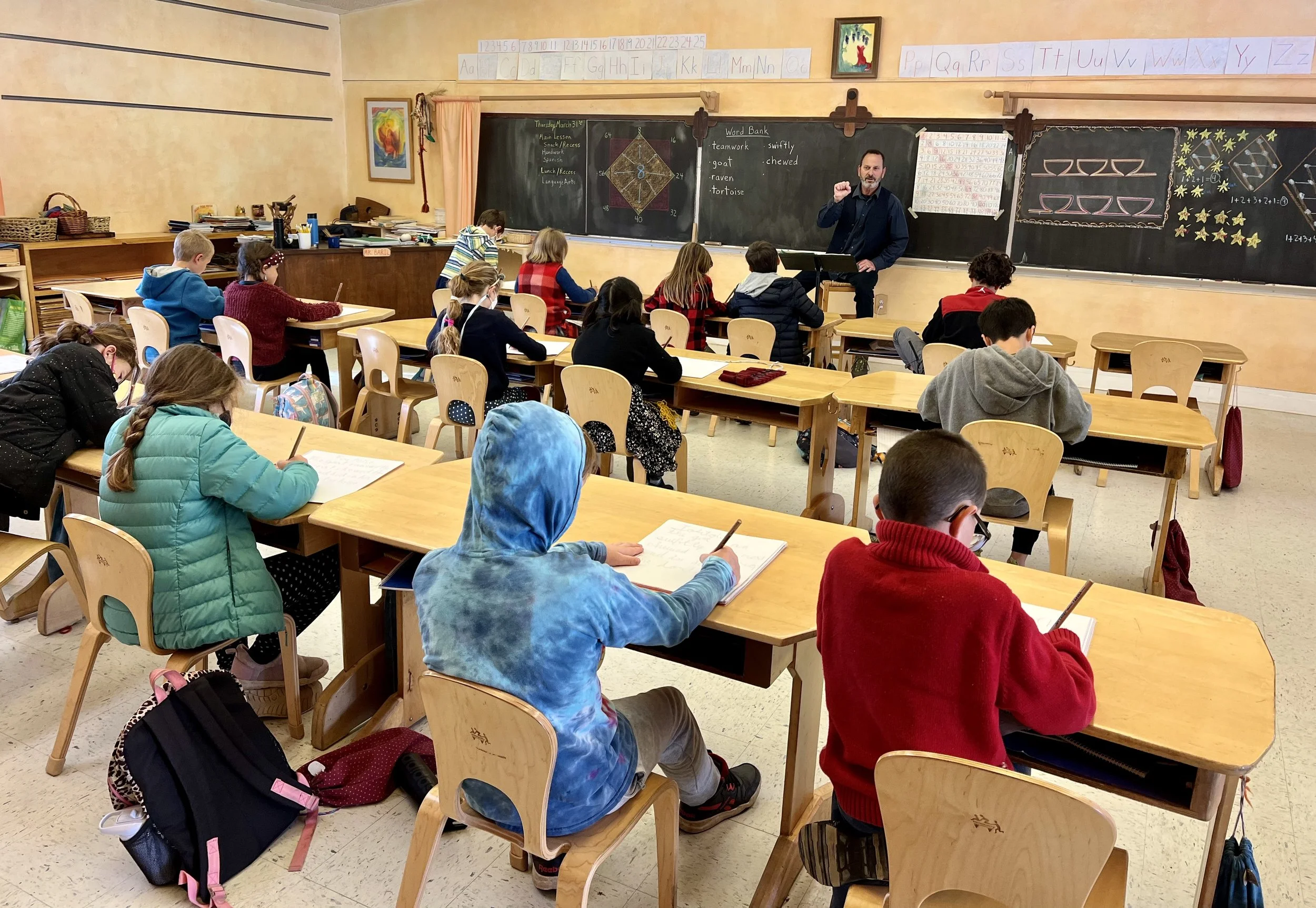
It’s morning in the 4th grade classroom at Marin Waldorf School and students are silently writing in their lesson books. The class teacher walks slowly between aisles of desks, checking work and occasionally leaning in to quietly share a comment.
It is a familiar classroom scene—one that, on first glance, looks similar to a class of students diligently completing a quiz or writing graded essays. But 4th graders at Marin Waldorf School don’t take tests or quizzes. They don’t receive letter grades or traditional report cards. And they are encouraged to cooperate, not compete, in the classroom.
How do our students become invested and diligent learners without grading? How do teachers measure and assess students progress without the standard toolkit of grades, tests, and quizzes? And how do parents know that their child is progressing academically?
Our Focus Is On Learning—Not Grades
“Grades create a preference for the easiest possible task. Impress on students that what they're doing will count toward their grade, and they will likely avoid taking unnecessary intellectual risks,” writes author and social scientist Alfie Kohn in the essay The Case Against Grading. According to Kohn, “Extrinsic motivation, which includes a desire to get better grades, often undermines intrinsic motivation, a desire to learn for its own sake.”
Marin Waldorf School classrooms provide daily proof that children are more likely to learn at the highest level when they are motivated by curiosity, close teacher-student relationships, and multisensory activities—like art and movement—that make learning enjoyable. Without grades, learning is unlimited, allowing exceptional students to reach their fullest potential. At the same time, students are supported through challenges in a school that emphasizes skill building, learning, and cooperation over competition and achievement.
“There’s this extrinsic motivation that’s tied to grades, which adds to student stress, and in some cases can lead to really unhealthy practices like perfectionism or great anxiety, paralysis. And it could also really turn kids off,” says Denise Pope, Ed.M.’89, a senior lecturer at Stanford, in the article The Problem With Grading, published by Harvard’s Graduate School of Education.
A Holistic Approach to Assessment
Evaluating each student’s progress is essential to every teacher’s work. Our faculty is specially trained to observe and evaluate a student’s academic, physical, social, emotional, creative, spiritual, and personal development, along with their executive functioning and organizational skills. Our approach is rooted in the understanding that each child is a unique individual—and our goal is to encourage each child to reach their potential, at a pace that supports meaningful learning.
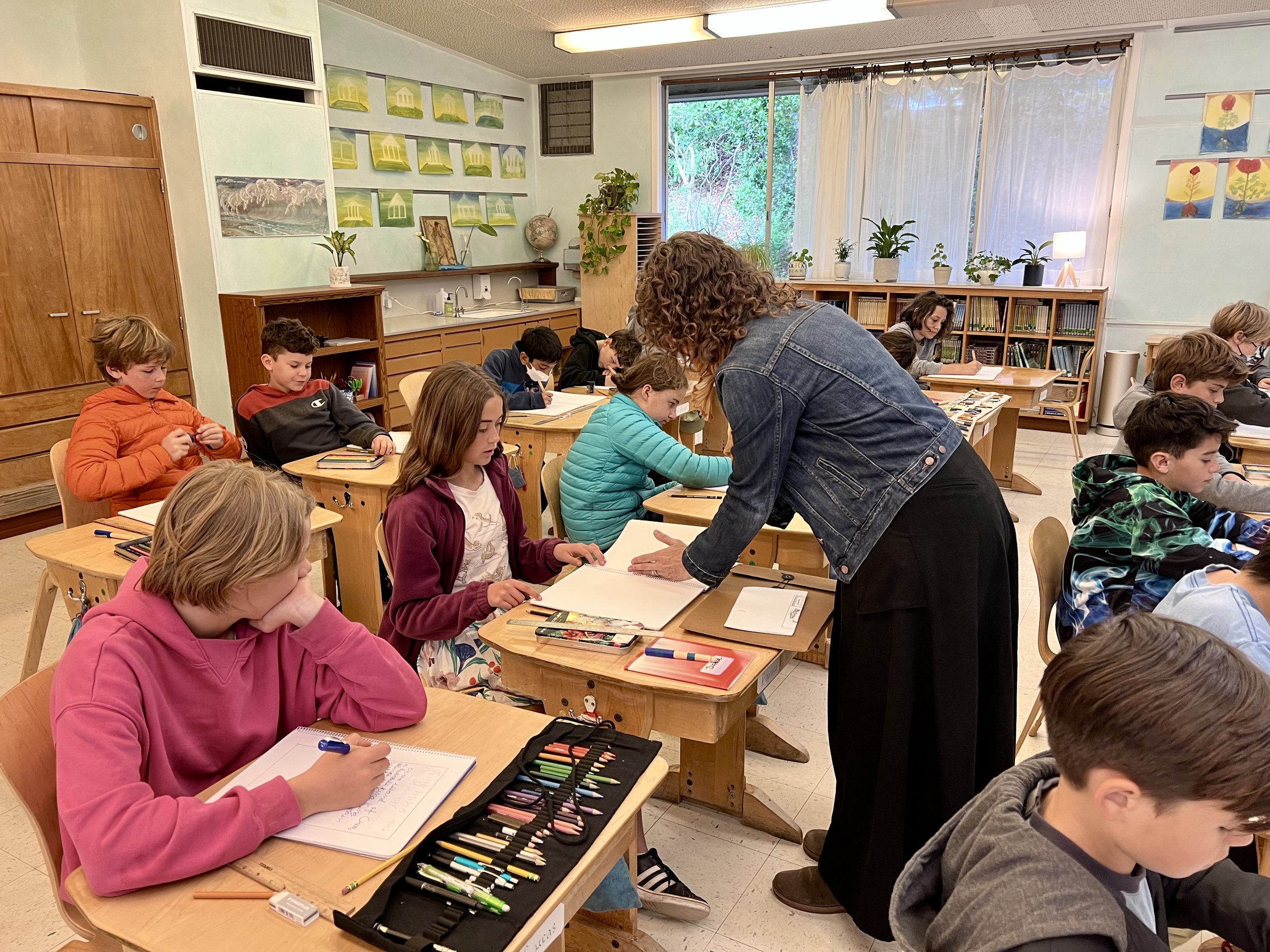
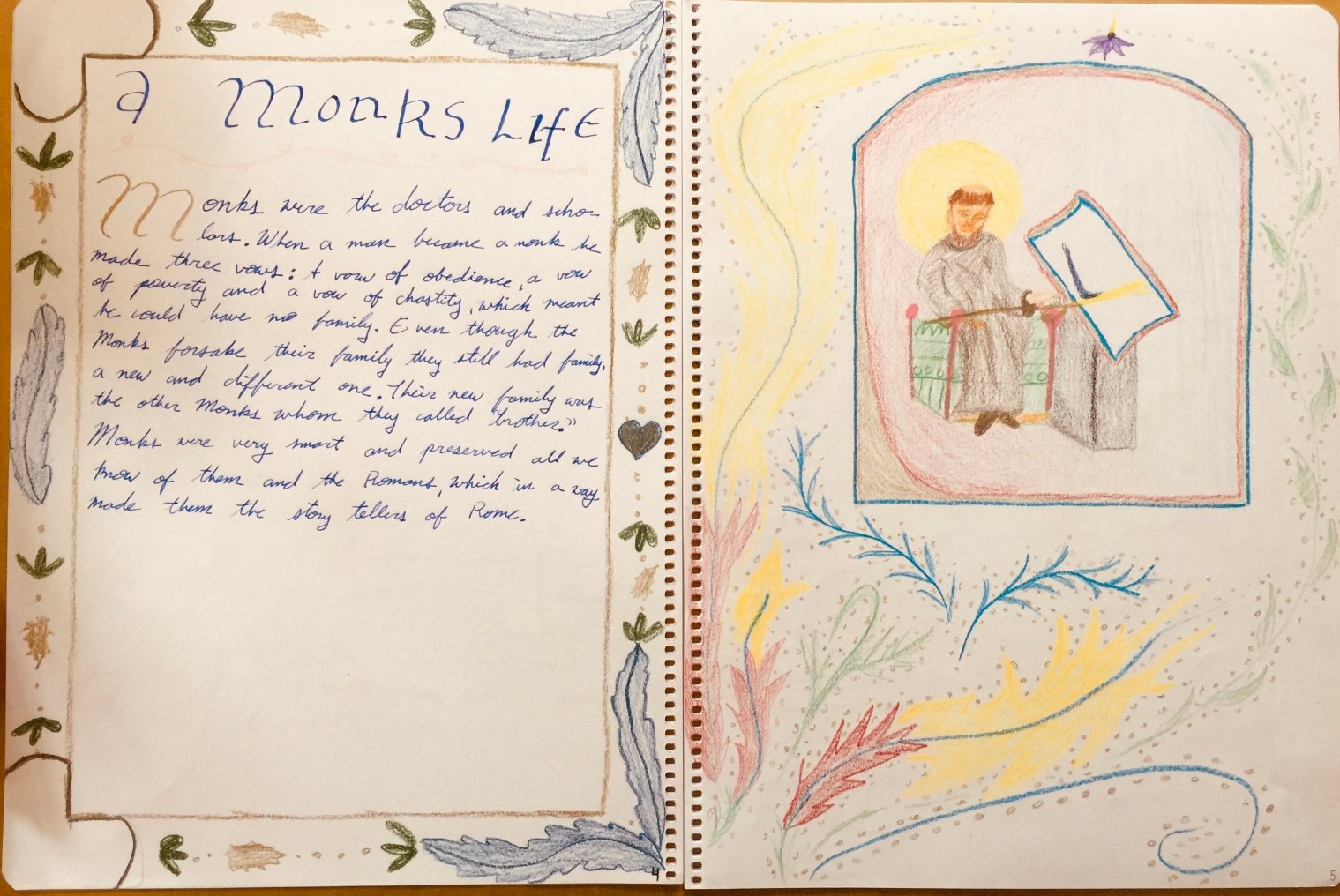
Working in partnership with the Educational Support Program Director, class teachers are continually observing their students, making note of each student’s strengths, challenges, and learning differences. Teachers also take time to closely examine each student’s main lesson book, where students record and illustrate what they are learning in class, reflecting their understanding and mastery of the material.
In addition, students are formally assessed every year for academic and developmental milestones, including pattern-based spelling, comprehension, vocabulary and reading fluency, and math, as well as developmental benchmarks. We don’t take a one-size-fits-all-approach to teaching, nor do we expect students to meet benchmarks at the same pace.
Meeting Academic Benchmarks
While parents appreciate the lower stress and increased camaraderie of the Waldorf classroom, many have questions about how we measure student progress. If we don’t use grades or tests to track student progress, how do our teachers know that children are meeting academic goals? And how do we know they will be prepared at the same level as their peers in other schools?
From early childhood to 8th grade, Marin Waldorf School’s curriculum is built around a carefully developed Scope and Sequence, which outlines the math, reading, literacy, and language arts skills taught at each grade level, within the context of the rich Waldorf curriculum. The Scope and Sequence gives teachers a framework to review student progress, with learning goals set for each grade level.
Our Scope and Sequence is not a standardized set of skills that all students are expected to achieve. As educators, we know and respect that students will arrive at benchmarks at a different pace; we use the Scope and Sequence to ensure that each class is progressing and that individual students are meeting agreed-upon standards.
Reports and Grading: Parents and Teachers in Partnership
At Marin Waldorf School, education is a partnership between home and school. Our teachers encourage parents to maintain open communication about student progress throughout the year, in addition to providing formal assessments several times a year.
In the late fall, parents preschool to 8th grade meet individually with their child’s class teacher. These meetings are an opportunity for parents to see student work, discuss developmental milestones, and exchange information about progress at home and at school. In addition, parents of students in grades 1-8 receive a written report twice a year: at the end of the first semester, in January, and at the end of the second semester, in July.
These reports include skills-based assessments based on our school’s Scope and Sequence alongside personal comments from teachers, observing a student’s progress through different areas of the curriculum, as well as their social-emotional development. These assessments provide a comprehensive and nuanced assessment of a student’s progress.
Making the Transition to High School
By middle school, most of our students are eager, motivated, and curious learners, steadily advancing in the academic and executive functioning skills they will need to succeed in high school. During the middle school years, students receive increased feedback and evaluation from their teachers, including a test and personal evaluation at the end of each main lesson block and biannual reviews from subject teachers.
While our students demonstrate intrinsic motivation to learn, we recognize that many of our graduates go on to public high school or to a more traditional private school where grading and standardized tests are the norm. Starting in 7th grade, our students receive a letter grade for each class in the curriculum, which are recorded in their midyear and end-of-year reports and will become a part of the student’s permanent transcript.
Okay, But How Do We Really Know It Works?
Check out the scores and percentiles for public Waldorf charters, which are required by law to administer standardized tests to their students. Reports show that Waldorf students consistently outperform their peers on standardized tests over the long term.